Best

Industrial Cable Assemblies factory

32Gbps Micro Coaxial Cable for USB4: Ultra-High-Speed Data Transmissi...

High-speed interconnects inside modern laptops, docks, and expansion devices increasingly rely on micro coaxial cable assemblies to carry USB4’s multi‑protocol, high‑bandwidth signals with stability and repeatability. This article explains what makes a micro coaxial cable truly “USB4‑ready” at 32Gbpsper differential pair, how it compares with passive USB4 Gen2/Gen3 cables, and how to select, validate, and integrate it for reliable next‑gen designs.


Understanding USB4, 32Gbps, and Why Micro Coax Matters

USB4 defines link rates of 20/40/80 Gbpsover USB‑C, with support for tunneling USB3.x, DisplayPort, and PCIe, while remaining backward compatible with USB 3.x/2.0. USB4 v2.0 adds PAM3signaling for up to 80 Gbpssymmetric or 120/40 Gbpsasymmetric rates, and upgrades DP tunneling to DP 2.1. For many system topologies—especially USB4 hubs, docks, and repeaters—the effective non‑display bandwidth often bottoms out at USB 3.2 20 Gbpsunless both sides support higher USB4 link rates. This is why multi‑lane designs and high‑quality differential pairs, often implemented with micro coax, are critical

A “32Gbps micro coaxial cable” in this context refers to a twin‑axial (micro coax) pair rated for 32 Gbit/s per differential pair, typically used as one or more lanes in a USB4 link. This is distinct from a “40Gbps passive USB4 cable,” which uses two lanes at 20 Gbit/seach to achieve the full USB4 Gen3 rate. Micro coax is favored for its tightly controlled impedance, excellent EMI shielding, and mechanical flexibility, enabling dense routing and consistent performance across bends and length transitions


How 32Gbps Micro Coax Enables USB4 Performance

Micro coaxial cables are constructed with a central conductor, precision dielectric, metallic shield, and outer jacket. This structure maintains constant impedanceand minimizes insertion loss, return loss, and crosstalkat multi‑gigabit frequencies. In USB4 implementations, multiple micro coax pairs are bundled to form the high‑speed lanes; the tighter the dimensional control and the better the shielding, the higher the usable bandwidth before equalization is required. For long or complex interconnects, active or redriver‑equipped assemblies can further extend reach while preserving eye‑mask margins

From a system perspective, USB4’s tunneling of PCIe(and USB3.x/DP) means the physical layer must preserve signal integrity across connectors, vias, and flexes. Micro coax’s superior shielding and impedance stability make it well‑suited for these hostile interconnect paths, especially in notebook hinges, docking stations, and internal device boardswhere space is constrained and EMI is abundant


32Gbps Micro Coax vs. Passive USB4 Cables

Aspect32Gbps Micro Coax (per differential pair)Passive USB4 Gen2/Gen3 Cable
SignalingTypically one lane at 32 Gbit/s(USB4 Gen2‑like)Two lanes at 20 Gbit/seach = 40 Gbit/s(Gen3)
Typical UseInternal links, repeaters, hubs, docksExternal C‑to‑C cables up to 0.8 m (Gen3)
ConstructionTwin‑axial pairs with precise impedance and shieldingMultiple twin‑axial pairs in a round jacket
ReachDepends on EQ/redriver; suitable for multi‑board paths0.8 mrecommended for passive Gen3
ComplianceMust be integrated into a USB4‑compliant systemCertified to USB4/USB‑IF (e.g., 40 Gbps, 100W, 8K)

Passive USB4 Gen3 external cables are widely available with 40 Gbpsdata, 100W PD, and 8K videosupport, with lengths commonly up to 0.8 mfor Gen3 passive designs. Internally, achieving 32Gbps per micro coax pair is a building block toward full USB4 Gen2/Gen3 system performance
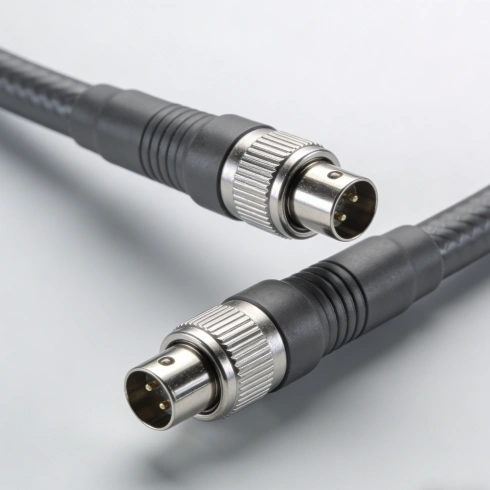
32Gbps micro coaxial cable

Designing with 32Gbps Micro Coax for USB4

  • •Target the Right Specs per LaneFor USB4 Gen2‑like performance, aim for 32 Gbit/sdifferential pair capability with low insertion loss and excellent return loss across your operating bandwidth. Ensure your system’s equalization, clocking, and lane bonding are configured for the intended link rate and topology6.
  • •Prioritize Impedance and ShieldingMaintain tight impedance control and 360° shielding in the micro coax bundle. Pay special attention to connector transitions, breakouts, and any geometry changes that can cause impedance discontinuities and mode conversion1.
  • •Manage Mechanical StressUse strain relief, consistent bend radii, and support structures to prevent micro‑bend‑induced losses. In hinge or rotating assemblies, consider the trade‑off between flexibility and loss across flex regions1.
  • •Plan for Reach and Active ComponentsIf the interconnect exceeds practical passive reach at 32Gbps, incorporate active equalization/redriversor active cableswith integrated chipsets. Active USB4 cables are common for lengths beyond ~1 m, with certified examples reaching 2 mwhile maintaining 40 Gbps3.
  • •Don’t Forget Power and E‑MarkerUSB4 systems negotiate power via USB PD(up to 100 Wfor many devices). Ensure your cable harness includes an E‑Markerwhen high current is required, and validate PD handshake and current capability at the system level4.

Validation and Testing Essentials

  • •Electrical ValidationPerform TDRfor impedance, S‑parametercharacterization (insertion/return loss, crosstalk), and eye‑diagramtesting at the target baud rate with your chosen equalization settings. Include worst‑case conditions: hot/cold, voltage margins, and connector mating cycles1.
  • •Protocol and ComplianceValidate USB4 link bring‑up, tunnel negotiation (USB3.x/DP/PCIe), and fallback behaviors. For external cables, use USB‑IF‑certifiedreference cables and test fixtures when available. For internal links, ensure interoperability with USB4 hubs, docks, and controllers in your ecosystem4.
  • •EMI/EMC and System‑Level TestingEvaluate radiated and conducted emissions with the micro coax harness installed. Shield continuity, connector grounding, and cable routing can significantly impact EMI performance in dense systems1.

Real‑World Examples and Ecosystem Signals

  • •Passive USB4 external cables supporting 40 Gbps, 100W PD, and 8K@60Hz(DisplayPort 1.4a with DSC) are widely available in lengths up to 1 mfor Gen3, with active designs reaching 2 m. These set the performance bar for USB4 system interoperability.
  • •USB4’s evolution to 80 Gbps(v2.0) and DP 2.1tunneling raises the bar for future‑proof designs. While many current devices operate at 20/40 Gbps, planning your interconnect with 32Gbps‑capable micro coax provides headroom for higher‑rate links and multi‑lane aggregation346.

When to Use 32Gbps Micro Coax in Your USB4 System

  • Docking stations and hubs: Multi‑board interconnects where space and EMI control are critical.
  • Laptop and tablet internal links: Hinge regions, display paths, and board‑to‑board connections.
  • External storage and expansion: High‑speed PCIe/USB3 tunnels that benefit from stable, shielded differential pairs.
  • Active cable assemblies: When reach or routing complexity would otherwise degrade passive performance.

Conclusion

A 32Gbps micro coaxial cableis a foundational element for achieving stable, high‑bandwidth USB4 links, especially inside devices where space, EMI, and mechanical constraints dominate. By understanding USB4’s multi‑protocol tunneling, the electrical demands of 32Gbps differential pairs, and the system‑level trade‑offs between passive and active designs, engineers can build interconnects that not only meet today’s 20/40 Gbpsrequirements but are also ready for the 80 Gbpsand DP 2.1capabilities of USB4 v2.0


Glossary

  • USB4: Universal Serial Bus 4, supporting 20/40/80 Gbps, tunneling of USB3.x/DP/PCIe, and backward compatibility.
  • Micro coaxial cable: Twin‑axial pair with controlled impedance and shielding for high‑speed differential signaling.
  • Gen2/Gen3: USB4 link rates of 20/40 Gbps(Gen2/Gen3).
  • PD (Power Delivery): USB Power Delivery protocol for negotiated power up to 100 W(or higher, depending on device support).
  • DP Alt Mode / Tunneling: Carrying DisplayPort over USB‑C or within USB4 tunnels, with DP 1.4a in USB4 v1.0 and DP 2.1in v2.0

More Industrial Cable Assemblies related Products

Heavy machinery cable assemblies

Heavy machinery cable assemblies are robust, high-performance connectivity solutions engineered to meet the demanding requirements of industrial and heavy-duty applications. Designed for durability, reliability, and optimal performance in.

More information
Corrosion-Resistant Cable Connectors | Durable & Weatherproof Sol...

Corrosion-Resistant Cable Connectors: Reliable Connectivity for Harsh Environments Ensure uninterrupted performance in the toughest conditions with our ​corrosion-resistant cable connectors. Designed for durability and longevity, these.

More information
INDUSTRIAL CABLE ASSEMBLIES PRODUCTS ONE

Industrial Cable Assembly Product Summary‌ ‌Material & Safety‌ Utilizes premium raw materials and globally recognized components (e.g., ABB, TE Connectivity)‌ ensuring high reliability and safety to prevent risks like fire and e.

More information
High-temperature resistant cable accessories

Ensure reliable power transmission and long-lasting performance in the harshest conditions with our ​High-Temperature Resistant Cable Accessories. Engineered to withstand extreme heat, these premium-grade accessories are designed to prote.

More information
High-load cable terminations

When it comes to electrical systems operating under extreme mechanical and electrical stress, ​high-load cable terminations are critical components that ensure seamless power transmission, safety, and system longevity. Engineered to .

More information
Protective cable kit

Meta Description: Discover the ultimate Protective Cable Kit designed to safeguard your cables from wear, tangles, and damage. Perfect for home, office, and industrial use. Shop now for long-lasting cable management! ​Protecti.

More information
Shielded cable core
Shielded cable core

In today’s technology-driven world, maintaining uninterrupted signal integrity is critical for industrial, commercial, and residential applications. The ‌Shielded Cable Core‌ is engineered to deliver superior electromagnetic interference .

More information
Quick-Install Cable Adapters

‌Product Overview‌Quick-Install Cable Adapters are the game-changing connectivity solution designed for professionals and DIY enthusiasts alike. Engineered to eliminate installation hassles, these adapters provide instant, tool-free conne.

More information
Industrial control cable module components

Meta Description: Discover high-performance industrial control cable module components designed for seamless automation, harsh environments, and superior connectivity. Explore specs, certifications, and applications. H2: Industrial Con.
More information
Industrial cable components

Industrial cable components are the backbone of reliable and efficient connectivity in industrial automation, robotics, and machinery. Engineered to withstand harsh environments while ensuring seamless data transmission and power delivery.

More information