The rise of AI and high-performance computing (HPC) is pushing data center interconnects beyond 400G. In 2026, 800G OSFP industrial cable assembliesare becoming the new baseline for AI data centers, providing the high density, low latency, and thermal resilience needed for next-generation infrastructure.
This article explains what these cables are, why they are critical for AI, and how to select and deploy them effectively.
📈 The AI Data Center Shift: Why 800G?
AI workloads, like large model training and inference, are creating massive east-west traffic within and between clusters. This has led to several key changes:
Explosive Growth: China’s data center capacity is projected to exceed 25 GW by 2025, with over 70% of new demand being AI/intelligent computing.
Rise of AIDC: AI Data Centers (AIDCs) are now a core part of national infrastructure, with intelligent computing expected to account for 35% of total computing power by 2025.
New Architectures: To support trillion-parameter models, the industry is moving towards ultra-high-density “supernodes” interconnected at 800G/1.6T speeds.
In this environment, data center industrial cable assembliesare no longer just passive links; they are critical enablers of performance, density, and reliability.
🔌 What Are 800G OSFP Industrial Cable Assemblies?
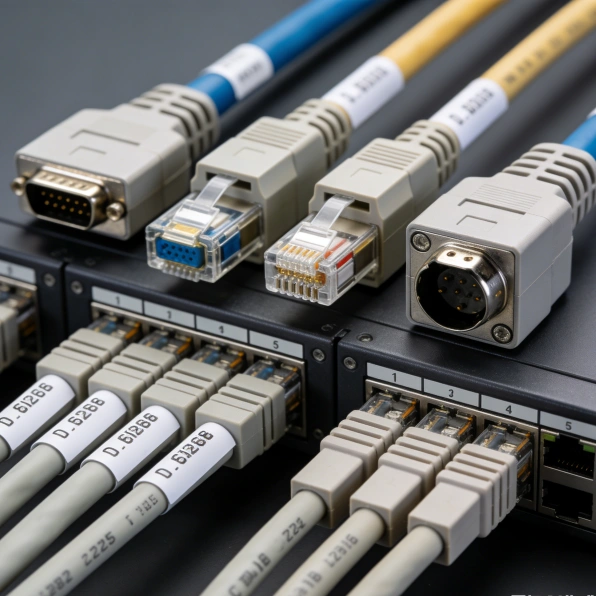
An 800G OSFP (Octal Small Form-factor Pluggable) cable assembly is a high-performance interconnect that terminates in OSFP connectors on both ends. It is designed for short-reach, high-bandwidth linksbetween switches, servers, and storage in data centers and HPC environments.
Key Technical Features:
Aggregate Bandwidth: 800 Gbps, achieved via 8 lanes of 100 Gbps (PAM4) or 112 Gbps (PAM4) each.
Form Factor: The larger OSFP housing supports up to 15W of thermal load and provides better airflow compared to QSFP-DD.
Cable Types:
DAC (Direct Attach Copper): Passive or active twinaxial cables for very short reaches (typically ≤3-5m).
AOC (Active Optical Cable): An active electrical-optical conversion cable for longer distances (typically 10-100m+).
ACC (Active Copper Cable): Features a redriver chip to extend the reach of passive DACs (e.g., 3-5m).
Industrial Grade: Supports extended operating temperatures from -40°C to +85°C, making them suitable for non-conditioned spaces.
💡 Why 800G OSFP is the New Standard for AI Data Centers
Bandwidth Density for Massive Parallelism AI training involves moving terabytes of data between GPUs. 800G OSFP’s high lane count and density are essential for building non-blocking, low-latency networks for thousands of GPUs.
Low Latency and Jitter OSFP DACs provide near-zero latency electrical paths, which is crucial for tightly coupled, RDMA-based AI workloads where microsecond differences impact job completion times.
Power and Thermal Efficiency Passive and low-power active OSFP cables consume minimal power (often <1W), reducing the load on data center cooling systems—a critical factor for the high-power density of AI racks.
Deployment Scalability and Cost-Effectiveness Compared to optical solutions, 800G OSFP DACs are significantly cheaper per port and easier to deploy, making them ideal for the scale-out phase of AI infrastructure.
Robustness for Challenging Environments With their industrial temperature rating and robust shielding, these cables are reliable in environments with high EMI, temperature fluctuations, or limited airflow, such as near-GPU racks or in modular data centers.
🛠️ OSFP vs. QSFP-DD: Key Differences
While both support 800G, they differ in design and application:
Smaller module, allows for higher port density per rack unit.
Power Handling
Designed for up to ~15W, suitable for high-power optics.
Supports high power but with tighter thermal constraints.
Adoption
Often the first choice for new 800G switch platforms.
Rapidly catching up, especially where maximum port density is the priority.
Choosing between them depends on your switch vendor, target port density, thermal design, and budget.
🗺️ Typical Deployment Scenarios for 800G OSFP Industrial Cables
Top-of-Rack (ToR) Switch Interconnects: Connecting ToR switches to leaf switches or GPU servers in EDA/ML training pods.
Spine-Leaf Links: Providing the high-bandwidth “fabric” in a leaf-spine architecture for AI clusters.
GPU-to-GPU Links: Used in scale-up architectures or within storage controllers where short, reliable links are needed.
Storage and SAN Interconnects: Enabling high-throughput, low-latency connections between storage arrays and AI compute nodes.
Harsh Environment Racks: Deployed in industrial settings or near high-heat equipment where standard cables might fail.
✅ How to Select the Right 800G OSFP Industrial Cable Assembly
Assess Reach and Topology: Use passive DACs for very short links (≤3m). Choose active DACs or AOCs for longer reaches (3-5m+).
Match the Ecosystem: Ensure OSFP compatibility with your switch vendor and planned migration path (e.g., QSFP112).
Verify Performance and Compliance: Look for cables supporting 112 Gbps PAM4 per lane, IEEE 802.3ck compliance, and low BER.
Evaluate Thermal and Mechanical Fit: Confirm the cable’s bend radius, flexibility, and connector strain relief are suitable for your dense AI rack layouts.
Plan for Management and Serviceability: Implement structured cabling practices like color-coding and labeling. Choose vendors with strong quality control and testing processes.
🚀 Planning Your 800G OSFP Deployment
Start with Workload and Topology: Model your AI/ML workloads to determine bandwidth, latency, and topology needs.
Adopt a Phased Approach: Begin with 400G for initial builds and scale to 800G as your GPU/ASIC deployments mature.
Integrate with Standards: Leverage open standards from organizations like OCP and OCTC to ensure interoperability and future-proofing.
Prioritize Sustainability: Select high-efficiency, low-power cables and partner with vendors who prioritize sustainable manufacturing.
🌐 The Future of Data Center Interconnects
The transition to 800G OSFP is a key step, but the journey doesn’t end there. The industry is already looking towards 1.6T OSFPand co-packaged optics to meet the demands of even larger AI models and more complex workloads.
For AI data center architects and engineers, understanding and adopting 800G OSFP industrial cable assemblies is essential for building scalable, reliable, and efficient infrastructure. The right interconnect today is the foundation for the AI breakthroughs of tomorrow.
In the complex ecosystem of industrial operations—from automated manufacturing lines to heavy-duty mining equipment, and from industrial robotics to critical power transmission systems—industrial cable connectors serve as the unsung her...
Introduction
Industrial robot cable assemblies serve as the lifelines of automation systems, requiring specialized materials to withstand dynamic movements, electromagnetic interference, and harsh industrial environments. This guide ...
Working in a foundry, furnace room, or next to high-power machinery? Standard cables will quickly become your weakest link. Choosing the right conductor material isn’t just about performance in high-temperature cable assemb...
Industrial cable assemblies are critical components in machinery, automation systems, energy infrastructure, and other heavy-duty applications. Choosing the right cable assembly ensures reliability, safety, and longevity in demanding en...
Voltage drop, which refers to the reduction in electrical potential along the length of a conductor when current flows through it, is a crucial factor that significantly affects the performance of industrial cables. Understanding its im...
In the complex network of electrical systems that power modern industries, cities, and daily life, two types of cables play pivotal roles but are often confused: industrial cable and power transmission cables. While both are designed to...
Industrial cables operating in low-temperature environments—such as polar industrial sites, freezing warehouses, low-temperature manufacturing equipment, or outdoor applications in cold regions—face unique challenges: material brittlene...
In industrial operations, the selection of cables is of great significance as it directly affects the safety, efficiency and environmental performance of the entire system. Among various cable types, halogen-free industrial cables have ...
Installing industrial cable is a critical step in launching a new facility, as it powers machinery, transmits control signals, and ensures operational safety. However, the cost of this process varies widely—typically ranging from \(15,0...
Industrial cable assemblies are the backbone of modern manufacturing, enabling seamless communication, power distribution, and data transfer across complex machinery and systems. In this article, we explore what industrial cable assembl...
The rise of 5G-enabled smart factories promises unprecedented levels of automation, real-time control, and IoT connectivity. However, the critical infrastructure enabling this revolution – industrial cable assemblies – faces unique desi...
In the dynamic landscape of industrial infrastructure, the reliability and performance of industrial cables are of paramount importance. As we step into 2025, several brands have emerged as frontrunners, setting the benchmark for qualit...
In the complex ecosystem of industrial equipment, an industrial wiring harness serves as the “nervous system” that connects and transmits electrical signals, power, and data between various components. Simply put, it is a bu...
Semiconductor manufacturing represents the pinnacle of precision manufacturing. Within the ultra-controlled environments of Class 1 to Class 5 (ISO 3 to ISO 5) cleanrooms, even the smallest contaminant – a particle of dust, a molecule o...
In industrial environments such as oil refineries, chemical plants, coal mines, and pharmaceutical workshops, where flammable gases, vapors, dust, or fibers may exist, explosion-proof industrial cables are critical components that ensur...
Industrial cables are the lifelines of modern industrial systems, responsible for transmitting power, signals, and data in a wide range of harsh and demanding environments. From manufacturing plants and power stations to oil refineries ...
When it comes to industrial cables, the choice between copper and aluminum is a critical decision that impacts performance, cost, and durability. Understanding the key differences and knowing which material suits specific applications c...
Chemical plants operate in an environment where danger lurks in every corner—flammable solvents, pressurized gas lines, and reactive chemicals create a tinderbox scenario. Among the many safety-critical components, flame-retardant (FR) ...
Industrial robots are the powerful muscles and precise tools of modern automation. But like any complex machine, they rely on a hidden network of lifelines: industrial cable assemblies. These aren’t your average wires; theyR...
Industrial cables are the “nerve system” of modern manufacturing, energy, and infrastructure—powering motors, transmitting control signals, and connecting critical equipment. Their performance directly impacts operational ef...
IntroductionIndustrial cable assemblies are critical components in power distribution, manufacturing, and infrastructure projects. Ensuring their safety, reliability, and longevity requires adherence to globally recognized standards lik...
Meta Description: Discover the best materials for cable assemblies in high-temperature environments. Learn about heat-resistant polymers, insulation options, and practical tips for durability and safety.
High-temperature env...
The soaring costs of metals like copper and aluminum, fundamental to power and data transmission cables, have long burdened infrastructure projects and manufacturers. A groundbreaking solution is emerging from the lab: lab-grown metals...
The cable industry, a backbone of modern technology, is poised for transformative changes by 2025. Engineers and industry experts are forecasting advancements driven by sustainability, digitalization, and evolving infrastructure demands...
Industrial settings like oil refineries, chemical plants, grain silos, and paint spray booths contain areas where flammable gases, vapors, dusts, or fibers can be present. Using standard electrical equipment here can trigger explosions....
In demanding industrial settings, the reliability of flexible industrial cable assembliesis paramount. These cables face constant bending, abrasion, and exposure to oils, chemicals, and extreme temperatures. A single point of failure ca...
Industrial cable assemblies are the backbone of modern manufacturing, automation, and connectivity. As industries evolve, so do the demands for smarter, more durable, and adaptable solutions. To stay ahead, businesses must understand th...
In modern factory automation, reliable connectivity is non-negotiable. The new IP67 industrial cable assemblies with M12-RJ45 connectorsare engineered to provide robust, dust-tight, and waterproof connections for industrial Ethernet and...
Industrial cable connectors are essential components in various industrial systems, enabling the reliable transmission of power, signals, and data. There are several common types, each designed to meet specific application requirements....
Imagine a state-of-the-art automotive assembly line grinding to a halt. Not because a robot arm malfunctioned, but due to a single, seemingly insignificant cable failure transmitting sensor data. This scenario underscores a fundamental ...
When upgrading heavy machinery, the weakest link is often not the engine or hydraulics, but the cable assemblies connecting sensors, actuators, and control systems. Standard M12 industrial cable assemblies can fail prematurely in high-v...
Industry 5.0: The Demand for Smarter ConnectivityIndustry 5.0 prioritizes human-centric automation, requiring cable assemblies to:
Enable Real-Time AI Interaction: Support <1ms latency for AI decision-making.Withstand Dyna...
In food processing plants, maintaining stringent hygiene standards is non-negotiable. Equipment must withstand rigorous sanitation protocols, including high-pressure washdowns, extreme temperatures, and exposure to corrosive chemicals. ...
Meta Description: Discover the critical performance metrics for industrial cable harnesses—from voltage rating to flex life—and learn how to evaluate quality for reliability and safety.
Table of ContentsWhy Performance Metrics Ma...
Electrical cable assemblies are integral components in nearly every industry that relies on electrical power or signal transmission. Unlike individual cables, these assemblies consist of multiple cables, wires, or conductors organized i...
Automated Guided Vehicles (AGVs) represent a cornerstone of modern industrial automation, driving efficiency in logistics, manufacturing, and warehousing. While navigation systems, batteries, and control software often capture the spotl...
Industrial cables are the lifeline of electrical systems in various industrial sectors, ranging from manufacturing plants and power generation facilities to oil refineries and transportation networks. Their role in transmitting electric...
IntroductionIn a landmark move to enhance fire safety across industries, international regulatory bodies have introduced updated Global Fire-Resistant Cable Standards. These standards aim to minimize fire risks, improve electrical safe...
Meta Description: Discover the ultimate Protective Cable Kit designed to safeguard your cables from wear, tangles, and damage. Perfect for home, office, and industrial use. Shop now for long-lasting cable management!
Protecti.
Meta Description: Discover high-performance industrial control cable module components designed for seamless automation, harsh environments, and superior connectivity. Explore specs, certifications, and applications.
H2: Industrial Con.
Contact Us
Feel free to reach out to us for any inquiries or orders.