In sectors where reliability is paramount, the role of a dependable Industrial Cable Supplieris critical. The right cables are the lifeline of any industrial system, ensuring seamless power and signal transmission. FRS Cables specializes in providing high-performance industrial cables and cable assemblies tailored to the most demanding applications.
What is an Industrial Cable?
Industrial cables are engineered for use in factories, plants, and other demanding environments. Unlike consumer cables, they are built to withstand:
Harsh Conditions:High/low temperatures, moisture, oil, chemicals, UV, and mechanical stress.
Continuous Movement:Bending and flexing in cable chains or robotic arms.
Electrical Rigors:High voltages, currents, and electromagnetic interference (EMI).
They are used to power machinery, transmit control signals, carry data, and connect sensors, forming the core infrastructure of modern industry .
Key Specifications to Consider
Selecting the right cable begins with a clear understanding of its technical specifications.
1. Voltage and Current Rating
Power Cables:Range from 300V to over 35kV, with medium voltage (MV) and high voltage (HV) types used in power plants and distribution.
Control/Signal Cables:Typically 300V to 600V, designed for low-energy control and instrumentation.
Sizing:The conductor’s cross-sectional area (AWG or mm²) must be sufficient to handle the load current while maintaining acceptable voltage drop .
2. Conductor Material and Stranding
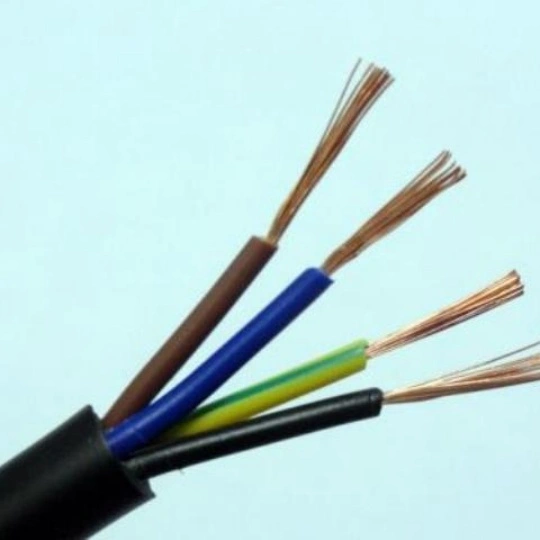
Material:High-purity copper(bare or tinned) is standard for its conductivity and flexibility. Aluminum is used for larger power cables to reduce weight and cost.
Stranding:Fine-stranded copperis essential for flexibility and fatigue resistance in moving applications, as it withstands repeated bending far better than solid wire .
3. Insulation Materials
The choice of insulation determines the cable’s thermal and chemical resistance.
Material
Max. Temp.
Key Properties & Uses
PVC
~70-90°C
Cost-effective, general-purpose.
XLPE
~90°C
Higher current capacity, used in power distribution.
Rubber (e.g., H07RN-F)
>90°C
Excellent flexibility and weather resistance for mobile equipment.
Teflon (PTFE/FEP)
>200°C
For extreme heat, chemical exposure, and aerospace.
PUR
~80-90°C
Oil, abrasion, and tear-resistant, ideal for dynamic applications.
4. Shielding
Crucial for data, signal, and control cables to combat EMI/RFI from motors and drives.
Types:Braided copper(superior flexibility) and aluminum foil(excellent low-frequency shielding). Often, a combination is used.
Cable Types:CY and SY cables feature steel wire braid for mechanical protection and EMI shielding, while flexible data cables use dense braiding and foils for high-speed signal integrity .
5. Jacket Materials
The outer jacket protects against abrasion, impact, moisture, and UV light.
PVC:General-purpose, oil and abrasion-resistant.
PUR:Superior oil, abrasion, and tear resistance; excellent for drag chains.
Rubber:Flexible and weather-resistant for mobile power.
LSZH (Low Smoke Zero Halogen):Emits minimal smoke and no corrosive halogens in a fire, critical for public spaces and tunnels .
6. Flexibility and Bend Radius
Flex Classes:Class 5is standard for stationary or slightly moving applications. Class 6is used for high-flex, continuous-motion applications like robotic arms.
Drag Chain Cables:Built to withstand millions of bending cycles with a defined minimum bend radius (e.g., 7.5x the cable diameter) .
7. Fire Performance
Flame Retardant (FR):Prevents the spread of fire.
Fire Resistant (FRLS):Maintains circuit integrity for a set period during a fire.
LSZH:Offers low smoke and zero halogen emissions, vital for life-safety .
8. Environmental Ratings
Temperature Range:Must be specified for both operation and storage (e.g., -40°C to +90°C).
Ingress Protection (IP Rating):Indicates resistance to dust and water (e.g., IP65, IP67) .
9. Compliance and Certifications
Look for certifications like UL, CSA, IEC, RoHS, and REACH, which ensure the cable meets international safety and environmental standards .
Performance in Demanding Environments
Cold Temperature Flexibility
In cold environments, standard PVC cables can harden and crack. For reliable operation, high-performance materials are essential:
TPU:Remains flexible down to approximately -40°C.
Silicone Rubber:Maintains flexibility down to -60°Cor lower .
High Flex and Mechanical Stress
Cables in automated systems must endure millions of flex cycles. Key design features include:
Fine-stranded conductors with high flexibility.
Torsion-resistant core design.
Abrasion-resistant, oil-resistant jackets like PUR.
Chemical and Oil Resistance
In industrial settings, cables are exposed to oils, coolants, and cleaning agents. PUR, rubber, and certain special PVCjackets are chosen for their superior resistance to these substances .
EMI Shielding for Data Integrity
In automation, reliable data transfer is non-negotiable. Double-shielded cables(braid + foil) with controlled impedance are used for protocols like EtherCAT and PROFINETto ensure signal integrity in electrically noisy environments .
Industrial Applications by Segment
1. Factory and Process Automation
Cables Used:Power, control, data (Ethernet, fieldbus), and high-flex drag chain cables.
Requirements:Continuous flexing, EMI resistance, and resistance to oils and coolants .
2. Robotics and Motion Systems
Cables Used:Ultra-high-flex cables for robot arms and torsion-resistant cables for cable tracks.
Requirements:Millions of bending cycles, compact bend radii, and resistance to oils and abrasion .
3. Energy and Power Distribution
Cables Used:Medium and high-voltage power cables, often XLPE-insulated.
Requirements:Long-term reliability, heat resistance, and fire safety (often LSZH) .
4. Renewable Energy
Solar:UV- and weather-resistant cables for rooftop and field installations.
Wind:Flexible, torsion-resistant cables for nacelles and towers that perform in a wide temperature range .
5. Heavy Industries (Mining, Oil & Gas)
Cables Used:Heavy-duty rubber or PUR cables with mechanical protection.
Requirements:Resistance to abrasion, crushing, chemicals, and extreme temperatures .
6. Transportation and Infrastructure
Cables Used:Rail, metro, and tunnel cables with flame-retardant and LSZH properties.
Requirements:High safety standards, fire resistance, and long service life .
7. Medical and Precision Equipment
Cables Used:Ultra-flexible micro-coaxial and high-speed data cables with precise impedance control.
Requirements:Miniaturization, high signal integrity, and reliability .
Partnering with FRS Cables
As a specialized Industrial Cable Supplier, FRS Cables offers a comprehensive range of solutions, from standard industrial cables to complex, custom cable assemblies.
Our Expertise
Product Range:We provide a wide portfolio, including flexible power and control cables, data communication cables, and specialized robotics and energy chain cables.
Custom Assemblies:Our core strength lies in custom cable assemblies. With extensive experience in fine-pitch micro-coaxial cables, LVDS, eDP, and more, we deliver high-precision solutions for industries like medical, industrial vision, and automation .
Quality and Certifications
Certified Quality:Our manufacturing is backed by ISO 9001, IATF 16949, and ISO 13485certifications, ensuring rigorous quality control.
Collaborative Design:Our engineers work closely with clients to define specifications, ensuring the optimal cable for each application.
Rapid Prototyping:We offer quick-turnaround samples and efficient mass production, helping you reduce time-to-market .
Global Reach, Local Service
Worldwide Shipping:We support customers globally with efficient logistics.
Responsive Support:Our team provides responsive communication and technical support to ensure your project’s success .
When your project demands cables that perform reliably under pressure, FRS Cables is the partner you can trust. We combine technical expertise, a commitment to quality, and a customer-focused approach to deliver industrial cable solutions that keep your operations running smoothly.
Contact FRS Cables today to discuss your specific requirements and experience the difference of working with a true Industrial Cable Supplier.
In high-performance automation, CE certified industrial cable assembliesare not just a compliance checkbox. They are a foundational element for ensuring safety, uptime, and seamless market access for your robots and automated guided veh...
Mining operations are known for their harsh and demanding environments, where equipment and components face extreme conditions. Among the crucial components, industrial cables play a vital role in ensuring the smooth and safe operation ...
In the intricate web of modern industrial operations, cables serve as the lifelines that power machinery, transmit critical data, and enable seamless communication across production lines, warehouses, and facilities. From manufacturing ...
In the harsh world of mining, cables face relentless punishment. Sharp rocks, heavy equipment, constant movement, and abrasive dust create an environment where ordinary cables fail quickly. Mining cable assemblies, however, are engineer...
Conductor: The Pathway for Electrical CurrentThe conductor is the central component that carries electrical current or signals. Its material and design directly impact conductivity, flexibility, and durability.
Key Materials:Co...
Choosing where your industrial cable assemblies come from isn’t just about cost or lead time – it’s a significant environmental decision. Sourcing these critical components locally offers a powerful, practical way to shrink ...
In industrial automation, manufacturing, and heavy machinery, industrial cables and wiring harnesses are both essential for electrical signal and power transmission—but they serve distinct roles. Confusing the two can lead to incorrect ...
Industrial cables serve as the “nervous system” of manufacturing plants, power grids, mining operations, and logistics hubs—transmitting critical power, data, and control signals to keep equipment running. Unlike residential...
High-frequency motors are widely used in modern industrial fields such as aerospace, automotive manufacturing, precision electronics, and medical equipment due to their high efficiency, fast response speed, and compact structure. Howeve...
In modern industrial production and automotive manufacturing, cables serve as the “nervous system” that transmits power and signals, ensuring the stable operation of equipment and vehicles. However, industrial cables and aut...
In humid industrial environments, corrosion of industrial cables is a prevalent and troublesome issue. It not only shortens the service life of cables but also poses serious threats to the normal operation of industrial production, pote...
Industrial cables are the backbone of modern manufacturing, energy distribution, and infrastructure operations. They transmit power, data, and control signals across factories, warehouses, power plants, and outdoor facilities—making the...
Telecommunications networks are the lifeline of the modern digital world—enabling everything from daily video calls and cloud computing to critical services like remote healthcare and smart city operations. At the core of these reliable...
Human-Machine Interface (HMI) systems serve as the critical bridge between operators and industrial machinery, enabling real-time monitoring, control, and data exchange in factories, manufacturing plants, and process facilities. At the ...
Electromagnetic Interference (EMI), including Radio Frequency Interference (RFI), poses significant challenges to signal integrity and equipment reliability within industrial environments. Understanding the specific factors that ca...
In the fast-paced world of industrial automation, connectivity is the nervous system of your operation. Yet, many engineers and procurement managers struggle with unreliable connections, messy wiring, and lengthy lead times.
If you a...
In industrial automation, vision systems serve as the “eyes” of intelligent production, responsible for high-precision tasks such as defect detection, dimension measurement, and position positioning. Industrial cable assembl...
In industrial automation, RFID (Radio Frequency Identification) readers play a critical role in asset tracking, inventory management, and process control. However, the performance of RFID readers heavily relies on industrial cable assem...
Industrial cables are vital components in various industrial settings, responsible for transmitting power and signals. When they get damaged, it can disrupt production and even cause safety hazards. Therefore, knowing how to repair them...
As 5G-enabled industrial automation pushes factories toward higher speeds, more sensors, and harsher operating conditions, the reliability of every physical connection is under unprecedented pressure. Chemical resistant industrial cable...
In the ever – evolving landscape of electronics and communication, the quality of cables used for signal transmission plays a pivotal role. Among these, coaxial cables with gold – plated contacts have emerged as a top choice...
The advent of 5G has ushered in an era of ultra-reliable, low-latency communication, demanding a new class of industrial cable assemblies. These assemblies are no longer simple wires; they are complex systems where precision, consistenc...
Recent advancements in high-voltage cable testing reveal a global regulatory shift towards stricter standards. With major economies implementing upgraded testing protocols, the power infrastructure sector faces both challenges and oppor...
1.TelecommunicationsCable assemblies ensure high-speed data transfer and connectivity in:Fiber optic networks: LC/SC/ST connectors and splice closures for telecom towers and data centers13.5G infrastructure: RF coaxial cables and ...
Industrial cable assemblies with overmolding integrate cables, connectors, and (in some cases) wire harnesses into a single, seamless unit using thermoplastic or elastomeric materials. This overmolding process goes beyond basic cable as...
In the complex ecosystem of industrial operations, wire connectors for industrial cables serve as the unsung heroes that ensure seamless and reliable electrical connectivity. These small yet critical components are responsible for joini...
In a smart factory, the network of industrial Ethernet, fieldbus, sensors, actuators, robots, and servo systemsis only as reliable as the cables connecting them. Downtime in such environments doesn’t just stop a single machine—it ...
1.Core Design SpecificationsA. Conductor RequirementsMaterial:Copper (bare, tinned, or silver-plated) for high conductivity.Aluminum for lightweight, high-voltage power transmission.Fiber optic strands for data-centric applications...
Cable assemblies are the lifelines of the energy sector, enabling the generation, transmission, and distribution of power across diverse environments—from offshore wind farms to underground oil rigs. As the global demand for energy grow...
Introduction
The 3D printing industry is evolving rapidly, with innovations focusing on improving precision, speed, and material versatility. One often-overlooked upgrade is the integration of flexible cables into 3D printers. These ...
The Hyperloop, a revolutionary transportation concept, promises to redefine speed and efficiency in mass transit. At its core, this technology relies on a complex network of industrial cables to ensure safety, performance, and reliabili...
The AI Revolution in Cable Production“Our defect rate dropped 40% in 6 months,” reveals John Carter, CEO of VoltCable Inc., in an exclusive interview about AI implementation. Traditional cable factories face three key challe...
As climate change accelerates, outdoor cables face unprecedented challenges from extreme weather conditions. From scorching heatwaves to bone-chilling freezes, these environmental stressors can significantly impact cable performance and...
When it comes to electrical cables, understanding the differences between industrial and marine cables is crucial for selecting the right option for specific applications. While both serve the purpose of transmitting electricity, their ...
When upgrading heavy machinery, the weakest link is often not the engine or hydraulics, but the cable assemblies connecting sensors, actuators, and control systems. Standard M12 industrial cable assemblies can fail prematurely in high-v...
In the era of Industry 4.0, industrial Ethernet cables serve as the lifeline of automated production lines, smart factories, and critical infrastructure. Unlike commercial Ethernet cables designed for office environments, industrial-gra...
Railway systems operate in some of the most demanding environments, where vibrations, shocks, and constant mechanical stress are unavoidable. Ensuring reliable performance under these conditions requires cable assemblies specifically de...
IntroductionIn a landmark move to enhance fire safety across industries, international regulatory bodies have introduced updated Global Fire-Resistant Cable Standards. These standards aim to minimize fire risks, improve electrical safe...
Meta Description: Discover the critical performance metrics for industrial cable harnesses—from voltage rating to flex life—and learn how to evaluate quality for reliability and safety.
Table of ContentsWhy Performance Metrics Ma...
Product OverviewQuick-Install Cable Adapters are the game-changing connectivity solution designed for professionals and DIY enthusiasts alike. Engineered to eliminate installation hassles, these adapters provide instant, tool-free conne.
Meta Description: Discover the ultimate Protective Cable Kit designed to safeguard your cables from wear, tangles, and damage. Perfect for home, office, and industrial use. Shop now for long-lasting cable management!
Protecti.
Contact Us
Feel free to reach out to us for any inquiries or orders.