Ensuring reliable, high-speed data transmission in industrial environments demands selecting the correct Cat6A patch cables built for harsh conditions. Here’s what to focus on:
Verified Cat6A Compliance:
Look for Certification: Cables must be independently tested and certified to meet or exceed Cat6A performance specifications defined in ANSI/TIA-568.2-D and ISO/IEC 11801 Ed 3 (or later). Demand documented proof (certificates, test reports).
Performance Guarantee: Certified Cat6A cables guarantee 10 Gigabit Ethernet (10GBASE-T) speeds up to 100 meters, operating at a frequency bandwidth of 500 MHz. They exhibit superior near-end crosstalk (NEXT) and attenuation characteristics compared to Cat6.
Shielding is Mandatory: Cat6A specifications require shielding to combat crosstalk and external interference (EMI/RFI) at high frequencies. Industrial settings intensify these challenges.
F/UTP (Foiled/Unshielded Twisted Pair): Overall foil shield + unshielded pairs. Common and effective for many industrial settings.
Heavy-Duty Jacketing:
Material: Thermoplastic elastomer (TPE), polyurethane (PUR), or specially formulated PVC offering superior oil resistance, chemical resistance, abrasion resistance, and wide temperature tolerance (e.g., -40°C to +85°C).
Flame Ratings: Look for LSZH (Low Smoke Zero Halogen) or plenum-rated (CMP) jackets for safety in confined spaces or areas with strict fire codes.
Enhanced Mechanical Durability: Industrial cables often feature thicker conductors, stronger filler materials, and overall designs resistant to crushing, continuous flexing (if required for the application), and repeated strain.
Industrial-Rated Connectors:
RJ45 Plugs/Jacks:
Metal Shielding: Full metal shielded connectors are essential to maintain the cable shield’s integrity. Look for robust die-cast zinc alloy housings.
Strain Relief: Integrated boots or features specifically designed for industrial strain relief on the cable entry point.
IP Rating (Optional but Recommended): For harsh environments (dust, moisture), connectors rated IP67 (or higher) provide critical ingress protection.
M-Style Connectors (Alternative):
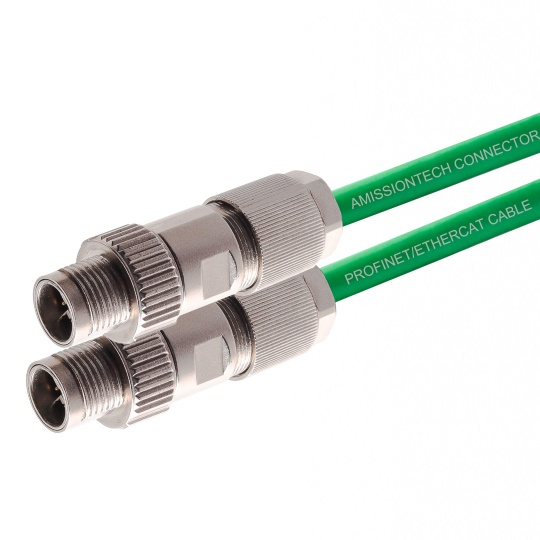
M8/M12 Connectors: Offer excellent vibration resistance, secure locking, and high IP ratings (IP67/IP68/IP69K). Commonly used on industrial machinery and sensors. Ensure they are specifically rated for Cat6A performance (e.g., “D-coded” M12).
Environmental Suitability:
M.I.C.E. Parameters: Consider the specific industrial environment:
Mechanical (M): Crush, impact, tensile load, flex life.
Climatic/Chemical (C): Temperature range, UV resistance, chemical/oil resistance.
Electromagnetic (E): EMI/RFI noise levels.
Temperature Range: Verify the cable’s operational temperature range suits your environment.
Certifications: Look for relevant approvals beyond networking standards (e.g., UL, CE, RoHS, specific industrial certifications like UL 444/Subject 2099, NEBS Level 3).
Length Considerations:
Use Correct Length: Use the shortest patch cable possible to minimize signal loss and potential points of failure. Avoid excessive coiling.
Test Performance: If manufacturing custom lengths beyond standard offerings, ensure they are rigorously tested end-to-end to Cat6A standards.
Key Selection Checklist:
Certified Cat6A: Verified performance to standards (ANSI/TIA, ISO/IEC).
Industrial Shielding: S/FTP or F/UTP construction.
Durable Jacket: Oil, chemical, abrasion, and temperature resistant (e.g., PUR, TPE).
Industrial Connectors: Shielded RJ45 with robust strain relief (and IP67+) or M8/M12 rated for Cat6A.
Environmental Match: Suitable M.I.C.E. parameters, temperature range, and certifications (UL, CE, RoHS, LSZH).
By rigorously applying these criteria, you select Cat6A industrial patch cables designed to withstand challenging conditions while guaranteeing the critical 10GBASE-T performance required for modern industrial networks.
Choosing the right cable assembly for your industrial application – whether grabbing one off-the-shelf or designing a bespoke solution – is crucial for performance, reliability, and cost-efficiency. Both pre-made and custom assemblies h...
Selecting compliant cable assemblies is critical for ensuring safety, performance, and adherence to industry standards. Whether you’re working in electronics, automotive, aerospace, or industrial applications, follow these steps to choo...
Finding a reliable industrial cable assemblies supplier is crucial. Their ISO 9001 certification should indicate a commitment to quality management. But how do you know it’s genuine? Don’t take claims at face value. Verifying ...
The development and operation of a modern medical device involve a complex interplay of cutting-edge technology, stringent safety regulations, and demanding environmental conditions. Off-the-shelf cable assemblies simply cannot meet th...
IntroductionNuclear power plants demand unparalleled levels of safety and reliability, especially for their critical control systems. These systems are the nerves of the plant, constantly transmitting vital data and commands. Crucially,...
In industrial settings—from manufacturing assembly lines and mining conveyor systems to railway traction networks—industrial cables serve as the lifeline of power transmission. However, power loss in these cables is inevitable, and its ...
In industrial operations, the selection of cables is of great significance as it directly affects the safety, efficiency and environmental performance of the entire system. Among various cable types, halogen-free industrial cables have ...
Finding reliable sources for high-quality industrial cable assemblies is crucial. These components power critical machinery, automation systems, and infrastructure, where failure is simply not an option. Here’s where to look for d...
Intermittent signal loss is one of the most frustrating issues plaguing industrial CAN bus systems. Unlike permanent faults, these elusive glitches disappear during testing, only to reappear under specific conditions, halting production...
When it comes to electrical systems, many people use the terms “industrial cable” and “electrical wires” interchangeably, but they are distinct components designed for different purposes. Understanding their diff...
In the fast-paced world of industrial automation, where precision, reliability, and efficiency are non-negotiable, every component plays a critical role in keeping operations running smoothly. Among these unsung heroes are industrial au...
Electromagnetic Interference (EMI) presents a significant challenge to the reliable operation of industrial machinery and control systems. While robust design aims for EMI immunity, industrial cable assemblies themselves can often...
In the modern industrial landscape, cables are the lifelines of operations—powering machinery, transmitting data, and enabling communication across factories, power plants, and infrastructure projects. However, the rapid growth of indus...
Chemical plants operate in an environment where danger lurks in every corner—flammable solvents, pressurized gas lines, and reactive chemicals create a tinderbox scenario. Among the many safety-critical components, flame-retardant (FR) ...
In the demanding world of aerospace, where failure is not an option and environments are extreme, industrial cable assemblies are fundamental components that go far beyond simple electrical connections. They are the critical nervous ...
Moisture inside outdoor cable terminations is a leading cause of failure in industrial settings. It leads to corrosion, short circuits, insulation breakdown, and costly downtime. Preventing water ingress is essential for reliability and...
Modbus has long been a cornerstone of industrial automation, enabling seamless data exchange between controllers, sensors, and actuators in factories, power plants, and manufacturing facilities. While the protocol’s simplicity and compa...
In high-performance automation, CE certified industrial cable assembliesare not just a compliance checkbox. They are a foundational element for ensuring safety, uptime, and seamless market access for your robots and automated guided veh...
In the complex and demanding landscape of industrial operations, the seamless and reliable transfer of power and data is the backbone of productivity. Among the critical components that ensure this seamless flow, industrial cable assemb...
Mineral-Insulated (MI) cables are a specialized type of electrical cable renowned for their exceptional durability and safety features, making them indispensable in various high-demand industries. Unlike traditional cables that rely on ...
In the ever-evolving landscape of modern technology, the demand for smaller, more efficient, and high-performance components has never been greater. This is particularly true in applications where space is at a premium, such as in aeros...
1. Cosmic Radiation: A Silent Threat
Space is filled with high-energy particles from solar flares and galactic cosmic rays. Standard cables degrade under prolonged exposure, leading to:
Signal interference – Disrupted data transm...
Industrial cables are the backbone of modern industrial operations, responsible for transmitting power, data, and signals across a wide range of machinery, equipment, and systems. Their reliable performance is crucial for ensuring the s...
Understanding Industrial Cable Model Naming ConventionsIndustrial cable models follow standardized codes indicating their construction, materials, and capabilities. Key elements include:
Conductor type: CU (copper), AL (aluminum...
Recent advancements in high-voltage cable testing reveal a global regulatory shift towards stricter standards. With major economies implementing upgraded testing protocols, the power infrastructure sector faces both challenges and oppor...
Meta Description: Discover key drivers, investment hotspots, and risk strategies for cable infrastructure in emerging economies. Data-driven analysis of fiber optic expansion and 5G integration opportunities.
The Rush to Eme...
As global temperatures rise and extreme weather events become more frequent, industries worldwide are rethinking infrastructure design to withstand environmental challenges. Among these innovations, climate-proof cables are emergi...
In today’s renewable energy sector, project timelines are tighter, budgets are under pressure, and reliability is non-negotiable. Whether you’re connecting solar arrays, wind turbines, or battery energy storage systems (BESS...
In industrial automation, mobile equipment is only as reliable as the cables that power and connect it. Downtime from a failed cable assembly can cost thousands of dollars per hour, making the right Industrial Cable Assemblies for Mobil...
In industries ranging from automotive manufacturing to marine engineering, and even in everyday outdoor electrical setups, waterproof cable connectors play a pivotal role in ensuring reliable electrical connections while safeguarding ag...
In today’s fast-paced manufacturing world, precision is non-negotiable—especially in industries like aerospace, automotive, and electronics, where a single faulty cable can lead to system failures or safety risks. Traditional cable asse...
1. The Rising Demand for Cost-Effective Medical Solutions
Hospitals worldwide face mounting pressure to reduce expenses without compromising quality. Medical cables—often overlooked—play a pivotal role in streamlining operations. Fro...
In the complex infrastructure of industrial facilities, the role of industrial cable installation services cannot be overstated. These services form the backbone of reliable power distribution, data transmission, and communication withi...
In today’s high‑speed industrial environments, reliable connectivity is non‑negotiable. Industrial cable assembliesserve as the nervous system of machinery, automation systems, and telecom infrastructure. At Top Electronics (FRS), we sp...
In today’s fast-paced technological landscape, industries demand cables that are not only high-performing but also adaptable to evolving needs. Enter modular design—a game-changing approach revolutionizing cable production. This articl...
The AI Revolution in Cable Production“Our defect rate dropped 40% in 6 months,” reveals John Carter, CEO of VoltCable Inc., in an exclusive interview about AI implementation. Traditional cable factories face three key challe...
When designing or upgrading electronic systems, industrial machinery, or communication networks, selecting the right cable assembly is critical. A poorly chosen cable assembly can lead to system failures, safety risks, and costly downti...
Cable systems are the vital circulatory network delivering power and data that keeps our modern world running. Yet, they operate largely out of sight and, too often, out of mind – until disaster strikes. A single cable failure can cripp...
Heavy machinery cable assemblies are robust, high-performance connectivity solutions engineered to meet the demanding requirements of industrial and heavy-duty applications. Designed for durability, reliability, and optimal performance in.
Industrial cable components are the backbone of reliable and efficient connectivity in industrial automation, robotics, and machinery. Engineered to withstand harsh environments while ensuring seamless data transmission and power delivery.
Contact Us
Feel free to reach out to us for any inquiries or orders.