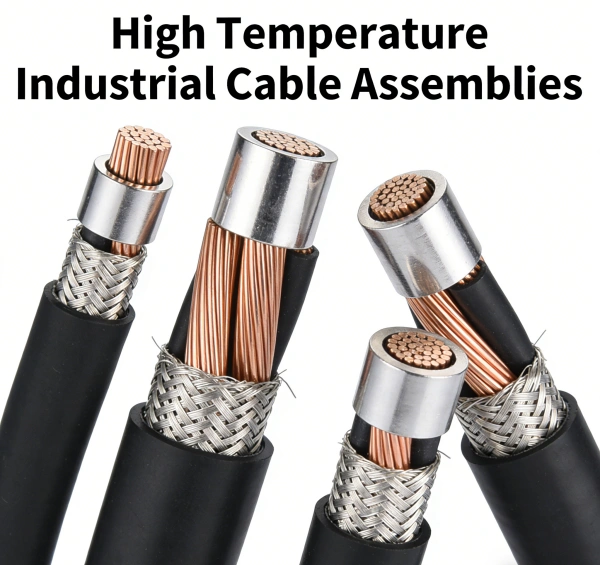
Selecting the correct insulation for high-temperature industrial cable assemblies is critical for safety, reliability, and longevity. A wrong choice can lead to premature failure, downtime, and even hazardous situations. This guide provides a detailed, practical comparison to help engineers, procurement managers, and project specifiers make an informed decision.
Understanding the Operating Environment
Before comparing materials, define your application’s specific demands:
Continuous Operating Temperature:The sustained temperature the cable will face.
Short-Term/Peak Temperature:Temperatures during process upsets or startup/shutdown cycles.
Chemical Exposure:Oils, solvents, acids, alkalis, or steam.
Mechanical Stress:Abrasion, flexing, vibration, or impact.
Electrical Requirements:Voltage rating, dielectric strength, and signal integrity needs.
Top High-Temperature Insulation Materials: A Detailed Comparison
Here’s a breakdown of the most common and effective materials for high-temperature industrial applications.
1. Silicone Rubber
Temperature Range:-60°C to +180°C (continuous), up to +200°C for some grades.
Key Strengths:Excellent flexibility, even at low temperatures. Good moisture and UV resistance. Inherently flame-retardant.
Weaknesses:Poor abrasion and cut-through resistance. Can be easily damaged if not protected by a suitable jacket or conduit.
Best For:Internal wiring in control panels near ovens, lighting systems in high-heat areas, and applications requiring frequent flexing.
Practical Tip:Always use a braided fiberglass or textile sleeve over silicone-insulated wires in high-abrasion environments.
2. ETFE (Ethylene Tetrafluoroethylene)
Temperature Range:-100°C to +150°C (continuous).
Key Strengths:Exceptional mechanical toughness—high tensile strength and abrasion resistance. Good chemical and radiation resistance. Lighter weight than many other fluoropolymers.
Weaknesses:Lower continuous temperature rating compared to PTFE or PFA.
Best For:Aerospace and military harnesses, robotics cables, and industrial automation where both heat and physical abuse are concerns.
3. FEP (Fluorinated Ethylene Propylene)
Temperature Range:-65°C to +200°C (continuous).
Key Strengths:Excellent chemical resistance. Melt-processable, allowing for extrusion over multi-conductor cables. Lower smoke and toxicity when burned compared to some materials.
Weaknesses:Softer than PTFE, making it more susceptible to cold flow (deformation under pressure).
Best For:Plenum cable in data centers, chemical plant wiring, and applications requiring good flexibility and chemical inertness.
4. PTFE (Polytetrafluoroethylene / Teflon®)
Temperature Range:-73°C to +204°C (continuous), with short-term peaks to +260°C.
Key Strengths:The industry benchmark for high-temperature and chemical resistance. Extremely low dielectric constant and loss, ideal for high-frequency signal cables. Excellent anti-stick properties.
Weaknesses:Difficult to process; requires specialized etching for bonding in potting or connectors. Can be brittle in thick sections and has poor cut-through resistance without protection.
Best For:Aerospace, military (MIL-SPEC), down-hole oil & gas tools, and any application where ultimate chemical/heat resistance is non-negotiable.
5. PFA (Perfluoroalkoxy Alkane)
Temperature Range:-65°C to +250°C (continuous), with peaks to +260°C.
Key Strengths:Combines PTFE’s chemical and heat resistance with FEP’s melt-processability. Excellent for extrusion and jacketing. Superior performance in severe chemical environments.
Weaknesses:Higher cost than PTFE and FEP.
Best For:High-performance wire and cable for chemical processing, pharmaceutical, and semiconductor industries where purity and chemical resistance are paramount.
6. Fiberglass & Mica Composites
Temperature Range:Up to +550°C (fiberglass), up to +1000°C or more (with mica).
Key Strengths:Withstand extremely high temperatures. Mica provides excellent electrical insulation even when hot.
Weaknesses:Brittle, not flexible. Primarily used as a wrap or tape, not a primary extruded insulation. Requires careful handling and often an outer protective sleeve.
Best For:Internal wiring of industrial furnaces, kilns, and heaters. Used as a protective wrap over primary insulated conductors in extreme heat zones.
7. PEEK (Polyetheretherketone)
Temperature Range:-60°C to +250°C (continuous).
Key Strengths:Outstanding mechanical strength and fatigue resistance at high temperatures. Excellent chemical and hydrolysis resistance. High radiation resistance.
Weaknesses:Very high material cost, limiting use to highly specialized applications.
Best For:Wire for down-hole drilling, aerospace engine compartments, and medical devices requiring autoclaving.
Quick Selection Guide by Temperature Range
Continuous Temperature
Recommended Primary Insulation
Key Consideration
Up to 105°C
Heat-Resistant PVC, XLPE
Cost-effective for many industrial controls.
105°C to 150°C
Silicone Rubber, ETFE
Balance of flexibility and toughness.
150°C to 200°C
Silicone (high-temp grade), FEP
Consider chemical exposure.
200°C to 260°C
PTFE, PFA
The standard for extreme heat and chemicals.
Above 260°C
Fiberglass/Mica wrapsover PTFE/PFA
Use as a protective layer; not a standalone insulation.
Critical Considerations & Common Pitfalls
Don’t Mix Materials Blindly:Using different insulation types in close proximity can lead to galvanic corrosion or compatibility issues, especially in high-heat, high-humidity environments. Consult with your cable manufacturer.
Voltage Derating is Essential:High temperatures reduce a cable’s voltage rating. Alwaysconsult the manufacturer’s derating curves. A cable rated for 600V at 20°C may only be safe for 300V at 200°C.
Beware of “Cheap” High-Temp Cable:Substandard materials may meet the temperature spec initially but fail rapidly due to poor aging characteristics. Verify supplier certifications and request material datasheets.
Consider the Entire Assembly:The insulation is only one part. Ensure connectors, potting compounds, and marking sleeves are also rated for the same high-temperature environment. A weak link anywhere can cause failure.
Mechanical Protection is Key:For PTFE and silicone, which have poor abrasion resistance, always specify an additional protective layer like a fiberglass or stainless steel braid, especially in high-vibration or abrasive environments.
Actionable Recommendations for Your Next Project
For General Industrial Ovens/Heaters (150-200°C):Start with silicone rubberinsulated wire, but always specify an overall fiberglass braidfor mechanical protection. Verify oil and chemical resistance if needed.
For Chemical Processing Plants (200°C+):PFAis often the best choice, offering the best balance of extreme temperature, broad chemical resistance, and processability. Use PTFEif the application is less mechanically demanding.
For Aerospace, Military, or Down-hole Tools:PTFEis the baseline. For areas with extreme mechanical stress (e.g., engine bays), consider ETFEfor its toughness or PEEKfor ultimate performance, if the budget allows.
For Furnace & Kiln Internal Wiring:Use a multi-conductor cable with PTFE-insulated conductors, an overall fiberglass or mica tape wrap, and a stainless steel braidfor protection.
Professional Summary
Choosing the best high-temperature insulation material is a balance of thermal performance, chemical resistance, mechanical durability, and cost. For temperatures up to 200°C, silicone rubber(with protection) and FEPare strong candidates. For the most demanding applications exceeding 200°C, especially with chemical exposure, PTFEand PFAare the industry standards. Always verify material compatibility, apply appropriate voltage derating, and protect softer insulations from mechanical damage. By carefully matching the material properties to your specific operating environment using the guidelines above, you can ensure the safety, reliability, and longevity of your high-temperature cable assemblies, minimizing costly downtime and failure risks.
The oil and gas industry operates in some of the harshest and most demanding environments on the planet, from deep-sea drilling rigs to high-temperature refineries and remote desert pipelines. In such settings, industrial cables play a ...
In the fields of electricity transmission and equipment connection, industrial cables and power cords are two common products, but their functional positioning, application scenarios, and performance requirements differ significantly. F...
Industrial printers, widely used in manufacturing, logistics, and packaging sectors, rely heavily on high-performance cable assemblies to ensure stable data transmission, reliable power supply, and consistent operational efficiency. The...
In the fast-paced world of industrial automation, every component plays a pivotal role in ensuring operational efficiency, reliability, and scalability. Among these components, cable assemblies stand out as the “nervous system” that con...
In the realm of industrial automation, manufacturing, and harsh environment operations, the reliability of connectivity solutions can make or break operational efficiency. Downtime caused by cable assembly failures—whether due to dust i...
Industrial cable overloading is a critical issue that can lead to catastrophic consequences—from equipment downtime and costly repairs to electrical fires and even safety hazards for workers. Unlike temporary power fluctuations, overloa...
In the intricate web of modern industrial operations, cables serve as the lifelines that power machinery, transmit critical data, and enable seamless communication across production lines, warehouses, and facilities. From manufacturing ...
Robots are machines defined by movement. From the precise arcs of welding arms to the dynamic scurrying of mobile platforms and the delicate interactions of collaborative robots (cobots), their joints and axes undergo constant, repetiti...
In industrial settings, electrical safety is of paramount importance. Industrial cable assemblies play a crucial role in enhancing electrical safety, and this article will explore the various ways they achieve this.
1. Superior Insul...
In the complex web of industrial operations, durable industrial cables serve as the lifelines, ensuring seamless power transmission, data communication, and signal transfer across diverse and often harsh environments. From heavy-duty ma...
The Nervous System of Smart Factories
Industrial cable assemblies serve as the central nervous system in smart manufacturing, transmitting power, data, and signals between machines, robots, and control systems. Their performance dire...
Agriculture, the backbone of global food security, is rapidly embracing automation and smart technology—and industrial cables are the unsung enablers of this transformation. Unlike ordinary cables, industrial-grade cables are engineered...
In the realm of heavy machinery operations, where colossal forces, relentless motion, and demanding environments converge, every component plays a critical role. Yet, one element often overlooked amid the roar of engines and the precisi...
In the heavy machinery industry, industrial cables serve as the “nervous system” and “energy pipeline” of equipment, connecting power sources, control systems, and execution components. Whether it is construction...
Industrial cables are the “blood vessels” of industrial systems, powering machinery, transmitting data, and ensuring the smooth operation of production lines. When cables fail, they can cause costly downtime, equipment damag...
Ensuring your fiber optic patch panels meet TIA (Telecommunications Industry Association) standards for insertion loss is crucial for maintaining network performance, reliability, and future-proofing. Non-compliant panels can lead to si...
High-speed sensor links in modern vehicles—from surround-view cameras to radar and satellite navigation—demand miniature interconnects that preserve signal integrity under harsh EMI/EMC and environmental conditions. This guide explains ...
Choosing the right industrial cable assembly brand isn’t about finding a single “best” option; it’s about matching rigorous specifications, application demands, and environmental challenges to the manufac...
Power plants stand as the backbone of modern energy supply, responsible for converting various energy sources (such as coal, natural gas, nuclear energy, and renewable energy) into electricity that powers industries, cities, and househo...
Electromagnetic compatibility (EMC) shielding is critical for ensuring reliable performance of industrial cables in environments plagued by electromagnetic interference (EMI). Whether in manufacturing plants, power grids, or automation ...
In the era of Industry 4.0, industrial Ethernet cables serve as the lifeline of automated production lines, smart factories, and critical infrastructure. Unlike commercial Ethernet cables designed for office environments, industrial-gra...
The worldwide transition to smarter, more resilient power networks is accelerating. Utilities are modernizing aging grids with digital monitoring, distributed energy resources (DERs), and advanced metering infrastructure (AMI). This shi...
In food processing plants, maintaining stringent hygiene standards is non-negotiable. Equipment must withstand rigorous sanitation protocols, including high-pressure washdowns, extreme temperatures, and exposure to corrosive chemicals. ...
In the complex landscape of industrial manufacturing and automation, flexible industrial wire assemblies stand as a critical connectivity backbone, enabling seamless power transmission, signal communication, and data exchange across a w...
Signal crosstalk – unwanted signal coupling between adjacent wires – wreaks havoc in industrial automation, causing data errors, measurement inaccuracies, and erratic equipment behavior. Here’s how to prevent it in your multi-conductor ...
When designing or upgrading systems that rely on cable assemblies, engineers and procurement teams often face a critical choice: customized or standardized solutions. Both options have distinct advantages, but understanding their diffe...
Automated Guided Vehicles (AGVs) represent a cornerstone of modern industrial automation, driving efficiency in logistics, manufacturing, and warehousing. While navigation systems, batteries, and control software often capture the spotl...
In 2026, industrial systems are more complex and densely packed with electronics than ever. As a result, shielded industrial cable assembliesare no longer just passive links; they are critical system components that determine equipment ...
IntroductionThe rapid evolution of nanotechnology has opened groundbreaking opportunities across industries, and the cable assembly sector is no exception. As demand grows for faster, safer, and more durable electrical systems, nanomate...
In today’s fast-paced technological landscape, industries demand cables that are not only high-performing but also adaptable to evolving needs. Enter modular design—a game-changing approach revolutionizing cable production. This articl...
In industries such as aerospace, automotive, oil and gas, and industrial manufacturing, cable assemblies face extreme conditions, with high temperatures posing a significant challenge. Selecting the right materials and adhering to indus...
In today’s fast-paced manufacturing world, precision is non-negotiable—especially in industries like aerospace, automotive, and electronics, where a single faulty cable can lead to system failures or safety risks. Traditional cable asse...
In today’s high‑speed industrial environments, reliable connectivity is non‑negotiable. Industrial cable assembliesserve as the nervous system of machinery, automation systems, and telecom infrastructure. At Top Electronics (FRS), we sp...
Selecting the right jacket material for industrial cable assemblies is critical. It directly impacts performance, longevity, and safety in demanding environments. PVC (Polyvinyl Chloride) and TPE (Thermoplastic Elastomer) are two leadin...
The automotive industry is undergoing a profound transformation. Driven by trends like electrification, intelligence, and flexible production, the traditional “thousands of cars on one line” model is giving way to smart factories capabl...
In today’s renewable energy sector, project timelines are tighter, budgets are under pressure, and reliability is non-negotiable. Whether you’re connecting solar arrays, wind turbines, or battery energy storage systems (BESS...
The cable industry is experiencing a seismic shift as eco-conscious consumers increasingly prioritize sustainability. Brands that have adopted green certifications, such as Energy Star, RoHS, or TCO Certified, are reporting significant ...
In a smart factory, the network of industrial Ethernet, fieldbus, sensors, actuators, robots, and servo systemsis only as reliable as the cables connecting them. Downtime in such environments doesn’t just stop a single machine—it ...
Cable assemblies are critical components in countless applications, from industrial machinery to consumer electronics. Proper maintenance ensures their reliability, safety, and longevity. Neglecting them can lead to costly downtime...
In today’s technology-driven world, maintaining uninterrupted signal integrity is critical for industrial, commercial, and residential applications. The Shielded Cable Core is engineered to deliver superior electromagnetic interference .
Corrosion-Resistant Cable Connectors: Reliable Connectivity for Harsh Environments
Ensure uninterrupted performance in the toughest conditions with our corrosion-resistant cable connectors. Designed for durability and longevity, these.
Contact Us
Feel free to reach out to us for any inquiries or orders.