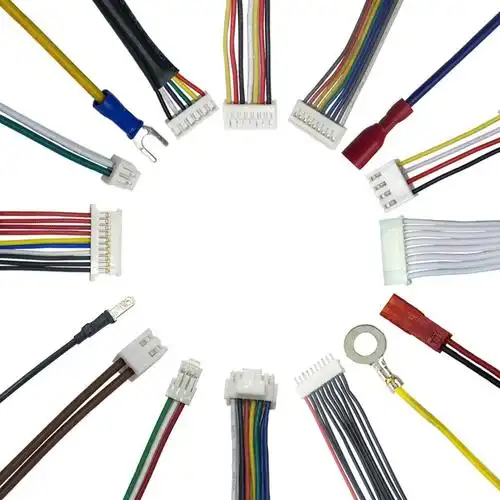
In high-throughput industrial automation, even a few minutes of unplanned downtime can cost thousands of dollars. For robotics cells, the weakest link is often not the robot itself, but the industrial automation cable assembliesthat power, control, and communicate with it.
This article explains how custom overmolded industrial cable assembliescan extend cable life, simplify maintenance, and help achieve significant downtime reduction—potentially up to 40%—by 2026.
🎯 Why Downtime from Cables Is a Growing Problem
Modern automation systems—robot arms, gantries, conveyors, and AGVs—depend on a complex web of industrial automation cable assembliesfor power, control, and data. These assemblies are often the most exposed and stressed components in the system.
Common failure points include:
- Mechanical Stress:Cables bent beyond their minimum bend radius in cable tracks or near robot joints.
- Environmental Wear:Jacket abrasion from repeated flexing against machine frames or cable chains.
- Connector Failure:Loose or broken strain relief, or moisture ingress at the connector-cable junction.
- EMI/Signal Loss:Shield breaks or poor grounding causing communication errors and emergency stops.
In many facilities, 20% of large companiesalready rely on industrial robots, and poor cable management is a known cause of malfunctions and costly repairs. As robot utilization grows, cable-related downtime becomes a critical bottleneck.
🔌 What Makes Industrial Automation Cable Assemblies Unique
Unlike generic hookup wire, industrial automation cable assembliesare engineered systems built to withstand the demands of factory automation.
- Integrated Functionality:They combine power, control, and data lines into a single, protected assembly, reducing wiring complexity and clutter.
- Harsh-Environment Materials:They use specialized conductors and insulation (e.g., PVC, PE, silicone, CPE) and robust outer jackets (e.g., PUR, TPE, rubber) resistant to abrasion, oil, chemicals, and extreme temperatures.
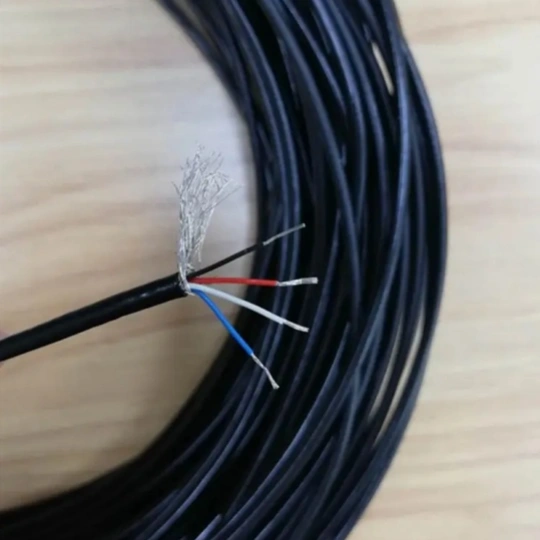
- EMI Shielding:They incorporate braided shields, foil shields, or both to protect high-speed data and control signals from electromagnetic interference (EMI) generated by motors and drives.
- Mechanical Durability:They are designed for dynamic applications with high-flex conductors, torsion resistance, and optimized bend radii for use in cable tracks and robotic joints.
🤖 The High Cost of “Good Enough” Cables in Robotics
In robotics, cables are in constant motion, making them prone to a unique set of failure modes.
- Premature Fatigue:Standard cables often can’t handle millions of flex cycles, leading to internal conductor breakage.
- Torsional Stress:Cables that can’t handle multi-axis twisting may develop internal shorts or breaks.
- Connector Strain:Point loads at the base of robot arms can crack solder joints or pull connectors loose.
- Routing Damage:Poorly managed cables in cable tracks can become pinched, crushed, or abraded, leading to intermittent faults.
The result is frequent, unpredictable failures that trigger emergency stops, scrambles for spares, and hours of lost production.
💡 How Custom Overmolding Solves These Problems
Overmoldingis a manufacturing process that encapsulates the cable end and connector in a single piece of molded material, such as TPE or PUR. This process creates a robust, unified component.
Key Benefits for Robotics & Automation
- 360° Strain Relief:Distributes bending and pulling forces over a large surface area, dramatically increasing cable life in moving applications.
- Environmental Sealing:The molded boot creates an IP65/IP67-rated seal, protecting against dust, water, coolants, and cleaning agents—critical for food & beverage and washdown environments.
- Mechanical Protection:The overmold acts as armor, shielding the connector and solder joints from impact, crushing, and abrasion.
- Vibration Resistance:A one-piece construction eliminates weak points, reducing the risk of connection failure in high-vibration environments.
- Improved Assembly & Logistics:Pre-made, labeled, and tested assemblies reduce field wiring errors and simplify changeovers.
📈 How This Translates to a 40% Downtime Reduction
The “40% downtime reduction” figure is a realistic target based on the compounded effects of improved reliability and faster maintenance. Here’s a breakdown:
- Fewer Failures:Custom overmolded cables can last 2-5 times longer in dynamic applications, directly reducing the frequency of unplanned stops.
- Faster Troubleshooting:A failed molded assembly is easy to identify and replace as a single unit, cutting mean time to repair (MTTR) from hours to minutes.
- Reduced Maintenance Burden:With fewer failures and simpler replacements, maintenance staff can focus on higher-value tasks, improving overall equipment effectiveness (OEE).
Important Note:The actual percentage will vary by application. However, a well-executed transition to custom overmolded assemblies consistently yields substantial downtime and cost savings.
🛠️ A Practical Roadmap to Implementation
Here’s a step-by-step guide to leveraging custom overmolded assemblies to cut downtime:
- Map Your Failure Modes:Analyze your top unplanned stop reasons related to cabling. Identify failure locations, motion types, and environmental stressors.
- Define Performance Requirements:For each critical circuit, specify voltage, current, data rate, bend radius, flex cycles, temperature, and ingress protection (IP) rating.
- Select the Right Materials:Choose conductors, shielding, and jacketing (e.g., high-flex conductors with PUR jackets) based on the application’s mechanical and environmental demands.
- Design for Manufacturability:Work with a supplier that uses automated termination and molding. Ensure strain relief geometries are optimized for flex life.
- Prototype & Test:Validate the design with flex, torsion, and environmental tests. Gather real-world cycle-count data before full rollout.
- Pilot & Scale:Start with your most problematic robot or production line. Use the data to build a business case for wider implementation.
🔮 Trends Shaping Cable Assemblies in 2026
By 2026, several trends will make robust cable solutions even more critical:
- Miniaturization & Higher Density:Smaller robots and tighter spaces will demand compact, high-density cable assemblies with finer conductors and shielding.
- Single-Pair Ethernet (SPE):SPE will simplify cabling for IIoT and robotics by carrying data and power over a single twisted pair, requiring new overmolding designs.
- Smarter Cable Management:AI-driven monitoring and advanced routing systems will reduce stress and wear, but only if paired with high-quality cables.
- Sustainability:Demand will grow for halogen-free, recyclable materials that don’t compromise performance.
✅ Key Takeaways
- In complex automation systems, industrial automation cable assembliesare a critical and often overlooked failure point.
- Custom overmolded industrial cable assembliesprovide superior strain relief, sealing, and durability, leading to longer life and faster repairs.
- A strategic shift to these assemblies can realistically reduce robot-related downtime by 30-40% or more, improving throughput and OEE.
- Success requires a data-driven approach: analyze failure modes, define requirements, prototype, and scale based on results.
If you’re battling cable-related downtime, the most effective first step is to analyze your failure data and partner with an experienced manufacturer to develop custom overmolded solutions for your most critical automation and robotics applications.