Ensuring reliable, high-speed data transmission in industrial environments demands selecting the correct Cat6A patch cables built for harsh conditions. Here’s what to focus on:
Verified Cat6A Compliance:
Look for Certification: Cables must be independently tested and certified to meet or exceed Cat6A performance specifications defined in ANSI/TIA-568.2-D and ISO/IEC 11801 Ed 3 (or later). Demand documented proof (certificates, test reports).
Performance Guarantee: Certified Cat6A cables guarantee 10 Gigabit Ethernet (10GBASE-T) speeds up to 100 meters, operating at a frequency bandwidth of 500 MHz. They exhibit superior near-end crosstalk (NEXT) and attenuation characteristics compared to Cat6.
Shielding is Mandatory: Cat6A specifications require shielding to combat crosstalk and external interference (EMI/RFI) at high frequencies. Industrial settings intensify these challenges.
F/UTP (Foiled/Unshielded Twisted Pair): Overall foil shield + unshielded pairs. Common and effective for many industrial settings.
Heavy-Duty Jacketing:
Material: Thermoplastic elastomer (TPE), polyurethane (PUR), or specially formulated PVC offering superior oil resistance, chemical resistance, abrasion resistance, and wide temperature tolerance (e.g., -40°C to +85°C).
Flame Ratings: Look for LSZH (Low Smoke Zero Halogen) or plenum-rated (CMP) jackets for safety in confined spaces or areas with strict fire codes.
Enhanced Mechanical Durability: Industrial cables often feature thicker conductors, stronger filler materials, and overall designs resistant to crushing, continuous flexing (if required for the application), and repeated strain.
Industrial-Rated Connectors:
RJ45 Plugs/Jacks:
Metal Shielding: Full metal shielded connectors are essential to maintain the cable shield’s integrity. Look for robust die-cast zinc alloy housings.
Strain Relief: Integrated boots or features specifically designed for industrial strain relief on the cable entry point.
IP Rating (Optional but Recommended): For harsh environments (dust, moisture), connectors rated IP67 (or higher) provide critical ingress protection.
M-Style Connectors (Alternative):
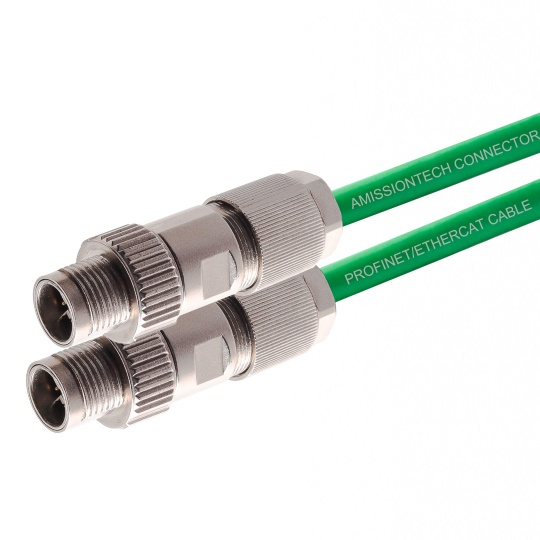
M8/M12 Connectors: Offer excellent vibration resistance, secure locking, and high IP ratings (IP67/IP68/IP69K). Commonly used on industrial machinery and sensors. Ensure they are specifically rated for Cat6A performance (e.g., “D-coded” M12).
Environmental Suitability:
M.I.C.E. Parameters: Consider the specific industrial environment:
Mechanical (M): Crush, impact, tensile load, flex life.
Climatic/Chemical (C): Temperature range, UV resistance, chemical/oil resistance.
Electromagnetic (E): EMI/RFI noise levels.
Temperature Range: Verify the cable’s operational temperature range suits your environment.
Certifications: Look for relevant approvals beyond networking standards (e.g., UL, CE, RoHS, specific industrial certifications like UL 444/Subject 2099, NEBS Level 3).
Length Considerations:
Use Correct Length: Use the shortest patch cable possible to minimize signal loss and potential points of failure. Avoid excessive coiling.
Test Performance: If manufacturing custom lengths beyond standard offerings, ensure they are rigorously tested end-to-end to Cat6A standards.
Key Selection Checklist:
Certified Cat6A: Verified performance to standards (ANSI/TIA, ISO/IEC).
Industrial Shielding: S/FTP or F/UTP construction.
Durable Jacket: Oil, chemical, abrasion, and temperature resistant (e.g., PUR, TPE).
Industrial Connectors: Shielded RJ45 with robust strain relief (and IP67+) or M8/M12 rated for Cat6A.
Environmental Match: Suitable M.I.C.E. parameters, temperature range, and certifications (UL, CE, RoHS, LSZH).
By rigorously applying these criteria, you select Cat6A industrial patch cables designed to withstand challenging conditions while guaranteeing the critical 10GBASE-T performance required for modern industrial networks.
In the complex and demanding landscape of industrial operations, the seamless and reliable transfer of power and data is the backbone of productivity. Among the critical components that ensure this seamless flow, industrial cable assemb...
Choosing where your industrial cable assemblies come from isn’t just about cost or lead time – it’s a significant environmental decision. Sourcing these critical components locally offers a powerful, practical way to shrink ...
In the complex and demanding world of industrial machinery, heavy-duty cables serve as the lifeline that ensures seamless power transmission, signal integrity, and operational reliability. Whether it’s in manufacturing plants, construct...
In industrial automation, manufacturing, and process control, reliable connectivity is the backbone of operational efficiency. Industrial Cable Assemblies – FRS (Flame Retardant Shielded) are engineered to meet the rigorous demand...
Robotics are transforming industries, from intricate assembly lines to demanding logistics centers. But what keeps these agile machines running smoothly? Often overlooked yet critical, high-flex industrial cable assemblies are the...
In industrial automation, marine, mining, and outdoor applications, cable assemblies often fail first—not because of the machine, but because of heat, oil, vibration, moisture, and poor installation. UL certified industrial cable assemb...
Cable safety standards are critical regulations ensuring the reliable and safe operation of electrical systems. These standards govern the design, manufacturing, installation, and maintenance of cables to prevent hazards like electrical...
Chemical plants operate in an environment where danger lurks in every corner—flammable solvents, pressurized gas lines, and reactive chemicals create a tinderbox scenario. Among the many safety-critical components, flame-retardant (FR) ...
Industrial environments demand cables that are tougher, smarter, longer-lasting, and more reliable than ever before. As machinery becomes more advanced and operations push into harsher conditions (extreme heat, chemicals, abrasion, EMI)...
While both industrial cables and utility cables serve the fundamental purpose of transmitting electrical power or signals, their design, performance, and application scenarios differ significantly. These distinctions arise from the uniq...
Industrial cables are the “nervous system” of automated systems—powering motors, transmitting sensor data, and enabling communication between controllers. Poor cable selection can lead to system malfunctions, unplanned downt...
In the modern industrial landscape, cables are the lifelines of operations—powering machinery, transmitting data, and enabling communication across factories, power plants, and infrastructure projects. However, the rapid growth of indus...
Agriculture, the backbone of global food security, is rapidly embracing automation and smart technology—and industrial cables are the unsung enablers of this transformation. Unlike ordinary cables, industrial-grade cables are engineered...
As we enter 2026, smart factories are rapidly adopting Industrial IoT, robotics, and high-speed automation. This shift makes industrial cable assemblies a critical component of operational efficiency. This article examines key 2026 tren...
In the industrial sector, industrial cables serve as the “nervous system” and “blood vessels” for power transmission, signal communication, and equipment connection. Whether it is logistics transportation plannin...
Industrial cable assemblies operate in demanding environments – think factory floors, offshore rigs, medical devices, or heavy machinery. Failure isn’t an option; it means downtime, repair costs, and potential safety hazards. Ensu...
Marine and industrial environments near water are brutal on electrical equipment. One critical defense against premature cable failure is the use of tinned copper conductors. Here’s why tinning is essential for reliable marine-gr...
In modern industrial settings—from automated assembly lines to robotic arms and conveyor systems—cables are not just passive transmitters of power or signals. They operate in constant motion, bending, twisting, and flexing hundreds or t...
The steel industry is a backbone of global manufacturing, relying on continuous, high-intensity operations across steelmaking, casting, rolling, and auxiliary processes. Industrial cables, as the “nerve and blood vessels” of...
Faulty cable assemblies are the hidden gremlins of industrial operations. They bring production lines to a standstill, cause costly downtime, and create potentially hazardous situations. Effective troubleshooting is essential. This guid...
Meta Description: Discover the critical performance metrics for industrial cable harnesses—from voltage rating to flex life—and learn how to evaluate quality for reliability and safety.
Table of ContentsWhy Performance Metrics Ma...
In the high-stakes environment of modern industrial automation, the difference between seamless production and catastrophic downtime often comes down to a single component: the connection. While controllers, sensors, and actuators get m...
Industrial cables serve as the “nerve and blood vessels” of modern manufacturing, power transmission, and automation systems, connecting critical equipment like motors, sensors, and control panels. In industrial environments...
As cyberattacks grow more sophisticated, organizations are rethinking physical infrastructure security. Shielded cables, once a niche solution for industrial settings, are now surging in demand as businesses prioritize holistic cybersec...
IntroductionThe rapid evolution of nanotechnology has opened groundbreaking opportunities across industries, and the cable assembly sector is no exception. As demand grows for faster, safer, and more durable electrical systems, nanomate...
IntroductionIn industries where harsh environments are the norm—such as automotive, industrial automation, marine, and telecommunications—cable assemblies must withstand dust, water, extreme temperatures, and mechanical stress. IP67 and...
In food processing plants, maintaining stringent hygiene standards is non-negotiable. Equipment must withstand rigorous sanitation protocols, including high-pressure washdowns, extreme temperatures, and exposure to corrosive chemicals. ...
Automated Guided Vehicles (AGVs) represent a cornerstone of modern industrial automation, driving efficiency in logistics, manufacturing, and warehousing. While navigation systems, batteries, and control software often capture the spotl...
In the complex ecosystem of industrial operations, wire connectors for industrial cables serve as the unsung heroes that ensure seamless and reliable electrical connectivity. These small yet critical components are responsible for joini...
IntroductionIn a landmark move to enhance fire safety across industries, international regulatory bodies have introduced updated Global Fire-Resistant Cable Standards. These standards aim to minimize fire risks, improve electrical safe...
Cable assemblies are the lifelines of the energy sector, enabling the generation, transmission, and distribution of power across diverse environments—from offshore wind farms to underground oil rigs. As the global demand for energy grow...
When designing or upgrading electronic systems, industrial machinery, or communication networks, selecting the right cable assembly is critical. A poorly chosen cable assembly can lead to system failures, safety risks, and costly downti...
Industrial cable assemblies are critical components in sectors like manufacturing, aerospace, energy, and automation. Selecting the right materials for these assemblies ensures reliability, safety, and longevity in harsh environments. H...
Selecting the correct insulation for high-temperature industrial cable assemblies is critical for safety, reliability, and longevity. A wrong choice can lead to premature failure, downtime, and even hazardous situations. This guide prov...
In large-scale infrastructure projects—particularly in transportation, tunnel systems, and railway applications—the integrity of electrical infrastructure is non-negotiable. Snake Trayspecializes in delivering robust industrial cable as...
Wind power systems operate in some of the planet’s most challenging environments—offshore platforms, deserts, mountainous regions, and icy tundras. These conditions demand robust infrastructure, and cable assemblies are no exception. As...
Introduction
In heavy industries like steel manufacturing, unexpected downtime can cost thousands per minute. XYZ Steel Plant recently achieved a 37% reduction in production interruptions by implementing custom-engineered cables – a ...
Mining operations are among the most demanding industrial environments, characterized by extreme temperatures, high mechanical stress, chemical exposure, and the constant risk of abrasion or impact. Heavy-duty industrial wires serve as ...
In applications where failure is not an option, such as military operations, aerospace systems, and certain industrial scenarios, military-grade coaxial cables are the go-to solution. These cables are engineered to meet the most demandi...
New energy cables (e.g., electric vehicle charging cables, in-vehicle high-voltage cables, and renewable energy system cables) must meet the following specialized technical requirements:
1. Electrical PerformanceHigh Voltage Capac...
Product OverviewQuick-Install Cable Adapters are the game-changing connectivity solution designed for professionals and DIY enthusiasts alike. Engineered to eliminate installation hassles, these adapters provide instant, tool-free conne.
Industrial cable components are the backbone of reliable and efficient connectivity in industrial automation, robotics, and machinery. Engineered to withstand harsh environments while ensuring seamless data transmission and power delivery.
Contact Us
Feel free to reach out to us for any inquiries or orders.