As robotics and high-flex automation evolve, the need for reliable, high-flex Mini-change industrial cable assemblies has never been greater. This 2026 guide explores the essential features, applications, and selection criteria for Mini-change (7/8”) cable assemblies, with a focus on robotic systems.
Why Robotics Demands High-Flex Mini-Change Cable Assemblies
Modern robotics, from industrial robot arms and cobots to humanoid robots and AGVs, require cable assemblies that can withstand constant, multi-axis motion, tight bend radii, and exposure to oils, coolants, and dust. Standard cables in these dynamic environments often fail due to broken conductors, cracked jackets, or loose connectors, leading to downtime and maintenance costs.
High-flex Mini-change cable assemblies are purpose-built for these challenges. They combine the robust, industry-standard Mini-change (7/8”) connector familywith high-flex cablesengineered for millions of flex cycles. This results in:
- Enhanced Robot Performance: Smoother, more reliable movement in articulated arms, SCARA, and delta robots.
- Extended Service Life: Reduced cable fatigue and failure in cable chains and rotating joints.
- Simplified Integration: A robust and standardized interconnect solution for power and signal transmission.
Understanding Mini-Change (7/8”) Connectors
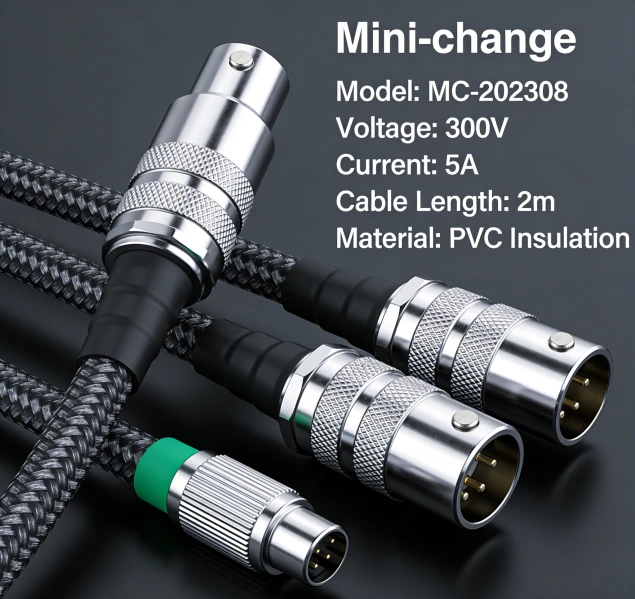
Mini-change connectors, also known as 7/8” circular connectors, are a rugged, sealed solution for industrial power and signal transmission. Key characteristics include:
- Standardized & Interchangeable: The 7/8”-16UN thread and industry-standard codings ensure easy integration and replacement.
- Robust & Sealed: Typically rated at least IP67, with some versions reaching IP68/IP69K, they protect against dust and water ingress, even in high-pressure washdown environments.
- High Current & Voltage: Available in 2 to 19 poles, they support significant power delivery. For example, Molex Mini-Change cordsets can handle 8–13 A per contactand 300–600 V, depending on the series and cable.
Common Configurations
- Coding & Poles: Available in A, B, and other codings for power or signal. Pole options range from 2 to 19, with common configurations for 3, 4, 5, and 8-pin setups.
- Cable Materials: Choose from PVC, PUR, TPE, or WSORjackets, selected based on environmental needs like oil resistance, flex life, or high-temperature performance.
- Assembly Types: Offered as single-ended cordsets, double-ended extension cables, or field-wireable connectors for on-site termination.
Key Features of High-Flex Mini-Change Assemblies for Robotics
A high-flex Mini-change cable assembly integrates a flexible cable with robust Mini-change connectors, designed for dynamic robotic applications.
1. High-Flex Cable Construction
These cables are built to last, featuring design elements crucial for robotics:
- Fine-Stranded Conductors: Maximize flexibility and fatigue resistance.
- Optimized Twisting & Layering: Ensures stability and prevents tangling during constant motion.
- Dedicated Tensile Elements: A central support structure enhances flex life and protects against breakage.
- Durable Jacket Materials: PUR, TPE, or WSORjackets provide excellent oil, abrasion, and tear resistance, ideal for industrial settings.
2. Rugged Connectors & Strain Relief
The connection points are reinforced to handle stress:
- Robust Housings: Made from impact-resistant materials like zinc die-cast, with options for epoxy coating to prevent corrosion.
- High-Quality Contacts: Gold-plated brass or phosphor bronze contacts ensure low contact resistance and reliable connections.
- Effective Sealing: O-rings and precision-machined threads maintain the IP67/IP68 rating, even under vibration.
- Integrated Strain Relief: Molds or overmolding at the cable-entry point protects the conductor-crimp junction from bending forces.
3. Environmental & EMI Protection
Robotic systems demand robust protection:
- Mechanical Protection: Abrasion-resistant jackets and optional armored or stainless-steel braid protect against physical damage.
- Chemical & Temperature Resistance: Jackets are selected based on exposure to coolants, oils, and operating temperatures (e.g., -40°C to +90°C).
- EMI Shielding: Tinned copper braid or foil shields with high coverage (e.g., >80%) are used for signal and data cables to prevent electromagnetic interference.
4. Flex Life & Performance Validation
Reliable manufacturers validate performance through rigorous testing:
- Flex Life Testing: Cables are tested for millions of cycles in bending or torsion machines that simulate real-world robot motion.
- Environmental Stress Testing: Includes temperature cycling, oil immersion, and chemical exposure tests.
- Electrical Performance Verification: Ensures stable contact resistance and high-voltage isolation after mechanical stress.
Typical Robotics Applications
High-flex Mini-change assemblies are ideal for various robotic and automation systems:
- Industrial Robot Arms: Powering and signaling servo motors, encoders, and end-effectors.
- Collaborative Robot (Cobot) Joints: Connecting joints with compact, shielded power and signal cables.
- Humanoid & Mobile Robots: Used in legs, arms, and sensor arrays where space and weight are critical.
- Automated Guided Vehicles (AGVs): Connecting navigation, battery, and control systems in dynamic environments.
- Robotic Vision Systems: Transmitting power and high-speed data for 3D cameras and laser scanners.
How to Specify the Right Assembly
To choose the optimal high-flex Mini-change cable assembly, consider the following factors:
- Voltage & Current: Determine the voltage and current per contact to select the appropriate pole count and wire gauge (e.g., 18–16 AWG).
- Signal or Data Requirements: Choose shielded twisted pairs for data or bus systems (e.g., DeviceNet, CC-Link). For power, focus on ampacity and jacket robustness.
- Environmental Conditions: Consider exposure to coolants, oils, high-pressure washdown, and temperature extremes to select the right jacket material (PVC, PUR, TPE, WSOR) and IP rating.
- Mechanical Motion: Analyze the robot’s motion profile (bending radius, torsion, speed) to determine the necessary flex life and cable type.
- Connector Details: Specify the exact connector type (male/female, straight/angled), coding (A/B), and pole count.
- Cable Length & Routing: Account for bend radii and potential cable slack to prevent overstressing the assembly.
Your Trusted Partner: RFS – High-Flex Mini-Change Cable Assemblies
RFS is a specialist in high-flex Mini-change industrial cable assemblies, dedicated to robotics and automation. Our 2026 new release features enhanced designs for longer flex life, improved chemical resistance, and optimized shielding effectiveness.
We provide comprehensive, end-to-end solutions:
- Custom Design & Prototyping: Our engineers work with your CAD models and motion profiles to create optimized assemblies.
- Rigorous Testing & Validation: We offer testing for flex life, environmental resistance, and electrical performance, providing full documentation.
- Scalable Manufacturing: From prototypes to high-volume production, our ISO-quality manufacturing ensures consistent quality and fast turnaround times.
Contact RFS todayto discuss your robotics project and discover how our high-flex Mini-change cable assemblies can enhance your system’s reliability and performance.
Contact Us Right Now:
E-MAIL: sales@custom-cable-assemblies.com