The rise of AI and high-performance computing (HPC) is pushing data center interconnects beyond 400G. In 2026, 800G OSFP industrial cable assembliesare becoming the new baseline for AI data centers, providing the high density, low latency, and thermal resilience needed for next-generation infrastructure.
This article explains what these cables are, why they are critical for AI, and how to select and deploy them effectively.
📈 The AI Data Center Shift: Why 800G?
AI workloads, like large model training and inference, are creating massive east-west traffic within and between clusters. This has led to several key changes:
Explosive Growth: China’s data center capacity is projected to exceed 25 GW by 2025, with over 70% of new demand being AI/intelligent computing.
Rise of AIDC: AI Data Centers (AIDCs) are now a core part of national infrastructure, with intelligent computing expected to account for 35% of total computing power by 2025.
New Architectures: To support trillion-parameter models, the industry is moving towards ultra-high-density “supernodes” interconnected at 800G/1.6T speeds.
In this environment, data center industrial cable assembliesare no longer just passive links; they are critical enablers of performance, density, and reliability.
🔌 What Are 800G OSFP Industrial Cable Assemblies?
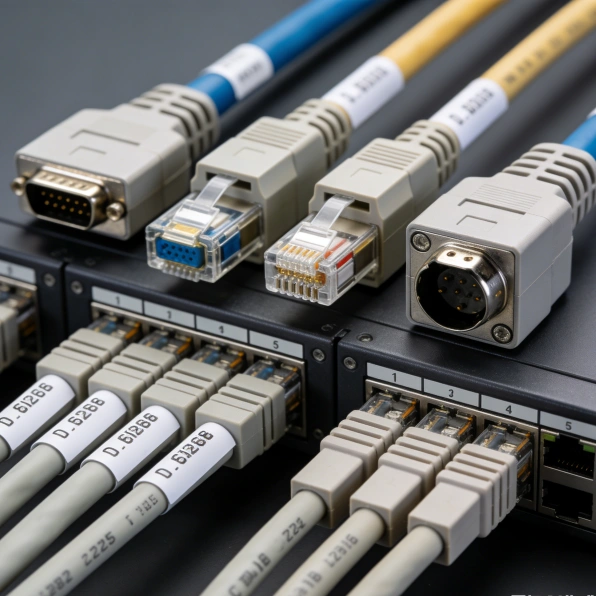
An 800G OSFP (Octal Small Form-factor Pluggable) cable assembly is a high-performance interconnect that terminates in OSFP connectors on both ends. It is designed for short-reach, high-bandwidth linksbetween switches, servers, and storage in data centers and HPC environments.
Key Technical Features:
Aggregate Bandwidth: 800 Gbps, achieved via 8 lanes of 100 Gbps (PAM4) or 112 Gbps (PAM4) each.
Form Factor: The larger OSFP housing supports up to 15W of thermal load and provides better airflow compared to QSFP-DD.
Cable Types:
DAC (Direct Attach Copper): Passive or active twinaxial cables for very short reaches (typically ≤3-5m).
AOC (Active Optical Cable): An active electrical-optical conversion cable for longer distances (typically 10-100m+).
ACC (Active Copper Cable): Features a redriver chip to extend the reach of passive DACs (e.g., 3-5m).
Industrial Grade: Supports extended operating temperatures from -40°C to +85°C, making them suitable for non-conditioned spaces.
💡 Why 800G OSFP is the New Standard for AI Data Centers
Bandwidth Density for Massive Parallelism AI training involves moving terabytes of data between GPUs. 800G OSFP’s high lane count and density are essential for building non-blocking, low-latency networks for thousands of GPUs.
Low Latency and Jitter OSFP DACs provide near-zero latency electrical paths, which is crucial for tightly coupled, RDMA-based AI workloads where microsecond differences impact job completion times.
Power and Thermal Efficiency Passive and low-power active OSFP cables consume minimal power (often <1W), reducing the load on data center cooling systems—a critical factor for the high-power density of AI racks.
Deployment Scalability and Cost-Effectiveness Compared to optical solutions, 800G OSFP DACs are significantly cheaper per port and easier to deploy, making them ideal for the scale-out phase of AI infrastructure.
Robustness for Challenging Environments With their industrial temperature rating and robust shielding, these cables are reliable in environments with high EMI, temperature fluctuations, or limited airflow, such as near-GPU racks or in modular data centers.
🛠️ OSFP vs. QSFP-DD: Key Differences
While both support 800G, they differ in design and application:
Smaller module, allows for higher port density per rack unit.
Power Handling
Designed for up to ~15W, suitable for high-power optics.
Supports high power but with tighter thermal constraints.
Adoption
Often the first choice for new 800G switch platforms.
Rapidly catching up, especially where maximum port density is the priority.
Choosing between them depends on your switch vendor, target port density, thermal design, and budget.
🗺️ Typical Deployment Scenarios for 800G OSFP Industrial Cables
Top-of-Rack (ToR) Switch Interconnects: Connecting ToR switches to leaf switches or GPU servers in EDA/ML training pods.
Spine-Leaf Links: Providing the high-bandwidth “fabric” in a leaf-spine architecture for AI clusters.
GPU-to-GPU Links: Used in scale-up architectures or within storage controllers where short, reliable links are needed.
Storage and SAN Interconnects: Enabling high-throughput, low-latency connections between storage arrays and AI compute nodes.
Harsh Environment Racks: Deployed in industrial settings or near high-heat equipment where standard cables might fail.
✅ How to Select the Right 800G OSFP Industrial Cable Assembly
Assess Reach and Topology: Use passive DACs for very short links (≤3m). Choose active DACs or AOCs for longer reaches (3-5m+).
Match the Ecosystem: Ensure OSFP compatibility with your switch vendor and planned migration path (e.g., QSFP112).
Verify Performance and Compliance: Look for cables supporting 112 Gbps PAM4 per lane, IEEE 802.3ck compliance, and low BER.
Evaluate Thermal and Mechanical Fit: Confirm the cable’s bend radius, flexibility, and connector strain relief are suitable for your dense AI rack layouts.
Plan for Management and Serviceability: Implement structured cabling practices like color-coding and labeling. Choose vendors with strong quality control and testing processes.
🚀 Planning Your 800G OSFP Deployment
Start with Workload and Topology: Model your AI/ML workloads to determine bandwidth, latency, and topology needs.
Adopt a Phased Approach: Begin with 400G for initial builds and scale to 800G as your GPU/ASIC deployments mature.
Integrate with Standards: Leverage open standards from organizations like OCP and OCTC to ensure interoperability and future-proofing.
Prioritize Sustainability: Select high-efficiency, low-power cables and partner with vendors who prioritize sustainable manufacturing.
🌐 The Future of Data Center Interconnects
The transition to 800G OSFP is a key step, but the journey doesn’t end there. The industry is already looking towards 1.6T OSFPand co-packaged optics to meet the demands of even larger AI models and more complex workloads.
For AI data center architects and engineers, understanding and adopting 800G OSFP industrial cable assemblies is essential for building scalable, reliable, and efficient infrastructure. The right interconnect today is the foundation for the AI breakthroughs of tomorrow.
With the global deployment of 5G technology, industrial scenarios such as smart manufacturing, outdoor communication base stations, marine operations, and underground mining are increasingly relying on stable and reliable 5G communicati...
In the fields of electricity transmission and equipment connection, industrial cables and power cords are two common products, but their functional positioning, application scenarios, and performance requirements differ significantly. F...
Choosing non-certified industrial cable assemblies might seem like a cost-saving move upfront. However, this decision exposes your business to significant hidden costs and risks that far outweigh the initial purchase savings. Here are t...
In the backbone of modern industrial operations—from manufacturing plants and power stations to oil refineries and data centers—industrial cables serve as the invisible lifelines that transmit power, data, and control signals. Without p...
In harsh industrial environments, standard cables often fail due to exposure to oils, coolants, acids, and cleaning agents. Chemical resistant industrial cable assembliesare engineered to maintain performance and lifespan where ordinary...
Customized wire harnesses are essential components in countless industries, but their complex nature can introduce manufacturing challenges. Applying Design for Manufacturing (DFM) principles early in the design phase is crucial for ens...
Tidal energy is a predictable and clean form of renewable power, but its marine environment—with high salinity, strong currents, and constant vibration—demands cabling systems that go beyond standard industrial specs. This is where cust...
Industrial cables are the lifelines of manufacturing plants, power grids, oil refineries, and other heavy-duty operations. Their reliable performance is critical to avoiding costly downtime, safety hazards (such as electrical fires or e...
In the global industrial supply chain, the European Union (EU) market stands out as a high-standard, high-value arena that demands strict compliance with safety, health, and environmental regulations. For manufacturers and suppliers of ...
Industrial cables serve as the lifeline of modern manufacturing, power transmission, and critical infrastructure. They facilitate the transfer of electricity, data, and control signals across factories, refineries, power plants, and oth...
The oil and gas industry operates in some of the most unforgiving environments on the planet—from deep downhole drilling sites where temperatures soar and pressure reaches extreme levels to offshore platforms exposed to saltwater corros...
Industrial cables are widely used in dynamic environments—such as robotic joints, sliding conveyors, and portable industrial devices—where repeated bending, twisting, or flexing is unavoidable. Poor flexibility can lead to insulation cr...
In the fast-paced and highly precise world of industrial automation, every component plays a pivotal role in ensuring seamless operations, reliable data transmission, and long-term durability. Among the myriad of connectivity solutions,...
Underwater installations, spanning offshore oil and gas exploration, submarine telecommunications, underwater renewable energy projects (such as tidal and wave power), and marine scientific research, rely heavily on industrial cables to...
In the complex and demanding landscape of industrial operations, every component plays a critical role in ensuring seamless productivity, safety, and longevity. Among these components, durable industrial cable stands out as an unsung he...
The medical industry operates on a foundation of precision, safety, and accountability—where even minor component failures can lead to life-threatening consequences. Industrial cables, though often overlooked, are the “nervous sys...
In the complex and demanding industrial environment, the reliability of electrical and data transmission systems directly affects the stable operation of the entire production line. Shielded industrial cables, as a key component in thes...
Construction sites are dynamic, high-stakes environments where every component plays a critical role in ensuring projects run smoothly, safely, and on schedule. Among the countless materials and equipment used, industrial cables stand o...
In the complex ecosystem of modern industry—from bustling automotive assembly lines and towering wind turbines to heavy-duty mining equipment and precision manufacturing hubs—vibration is an inescapable reality. Motors hum, conveyors ru...
Power plants stand as the backbone of modern energy supply, responsible for converting various energy sources (such as coal, natural gas, nuclear energy, and renewable energy) into electricity that powers industries, cities, and househo...
IntroductionThe rapid evolution of nanotechnology has opened groundbreaking opportunities across industries, and the cable assembly sector is no exception. As demand grows for faster, safer, and more durable electrical systems, nanomate...
The Hyperloop, a revolutionary transportation concept, promises to redefine speed and efficiency in mass transit. At its core, this technology relies on a complex network of industrial cables to ensure safety, performance, and reliabili...
Signal crosstalk – unwanted signal coupling between adjacent wires – wreaks havoc in industrial automation, causing data errors, measurement inaccuracies, and erratic equipment behavior. Here’s how to prevent it in your multi-conductor ...
In high-throughput industrial automation, even a few minutes of unplanned downtime can cost thousands of dollars. For robotics cells, the weakest link is often not the robot itself, but the industrial automation cable assembliesthat pow...
In modern factory automation, reliable connectivity is non-negotiable. The new IP67 industrial cable assemblies with M12-RJ45 connectorsare engineered to provide robust, dust-tight, and waterproof connections for industrial Ethernet and...
Medical device cable assemblies are critical components in healthcare systems, connecting devices like patient monitors, imaging equipment, infusion pumps, and surgical tools. Ensuring their safety and compliance with industry standards...
The Critical Need for Safety in Mining Operations
The mining industry faces unique electrical hazards due to flammable gases, combustible dust, and volatile atmospheres. Traditional cabling systems pose ignition risks, accounting for...
In industries ranging from oil and gas to pharmaceuticals, chemical-resistant cable assemblies are critical components that ensure safety, reliability, and longevity in harsh environments. Exposure to aggressive chemicals, extreme tempe...
High temperature industrial cable assemblies are no longer a niche product; they are a critical enabler of smarter, more automated, and more reliable manufacturing. As factories push for higher throughput, tighter quality control, and g...
1. The Rising Demand for Cost-Effective Medical Solutions
Hospitals worldwide face mounting pressure to reduce expenses without compromising quality. Medical cables—often overlooked—play a pivotal role in streamlining operations. Fro...
In demanding industrial environments, reliable interconnections are not optional—they are the backbone of your system’s performance and safety. Industrial Cable Assembliesencompass a wide range of engineered cable and wire harness solut...
Mining operations are among the most demanding industrial environments, characterized by extreme temperatures, high mechanical stress, chemical exposure, and the constant risk of abrasion or impact. Heavy-duty industrial wires serve as ...
Understanding Industrial Cable Model Naming ConventionsIndustrial cable models follow standardized codes indicating their construction, materials, and capabilities. Key elements include:
Conductor type: CU (copper), AL (aluminum...
IntroductionIn industries where harsh environments are the norm—such as automotive, industrial automation, marine, and telecommunications—cable assemblies must withstand dust, water, extreme temperatures, and mechanical stress. IP67 and...
As cyberattacks grow more sophisticated, organizations are rethinking physical infrastructure security. Shielded cables, once a niche solution for industrial settings, are now surging in demand as businesses prioritize holistic cybersec...
Electrical Performance: Powering Precision1.1 Voltage and Current RatingsIndustrial cable assemblies are categorized by voltage classes:
Low Voltage (LV): Up to 1,000V AC / 1,500V DC for robotics, PLCs, and conveyor systems.M...
In the aerospace industry, where every ounce matters, lightweight cables have emerged as a game-changer. These cables not only reduce the overall weight of aircraft and spacecraft but also enhance performance, efficiency, and safety. Le...
The integration of wireless charging technology into industrial cables is transforming how industries manage power delivery in demanding settings. From manufacturing plants to logistics warehouses, this innovation addresses long-s...
IntroductionAs the global push for clean energy intensifies, hydrogen projects are emerging as a cornerstone of decarbonization strategies. However, these initiatives face a critical challenge: ensuring their infrastructure aligns with ...
The advent of 5G has ushered in an era of ultra-reliable, low-latency communication, demanding a new class of industrial cable assemblies. These assemblies are no longer simple wires; they are complex systems where precision, consistenc...
Ensure reliable power transmission and long-lasting performance in the harshest conditions with our High-Temperature Resistant Cable Accessories. Engineered to withstand extreme heat, these premium-grade accessories are designed to prote.
Meta Description: Discover high-performance industrial control cable module components designed for seamless automation, harsh environments, and superior connectivity. Explore specs, certifications, and applications.
H2: Industrial Con.
Contact Us
Feel free to reach out to us for any inquiries or orders.