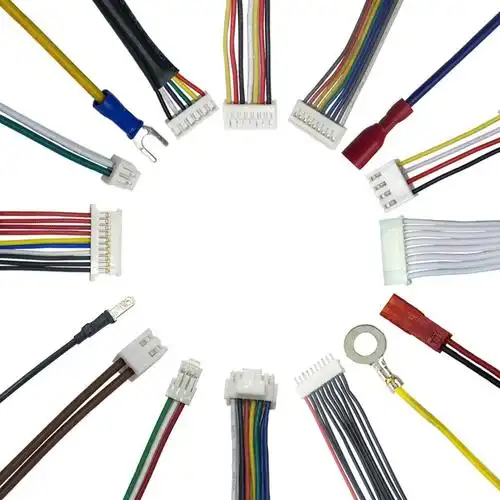
The relentless push towards smarter, faster, and more connected factories is fundamentally reshaping the requirements for electrical interconnects. At the heart of this evolution are multi-core industrial cable assemblies, which serve as the critical nervous system for modern automation, linking sensors, actuators, drives, and controllers. As industrial automation systems grow more complex, the demand for high-performance, reliable, and customized cable assemblies has surged, compelling suppliers to innovate in materials, design, and manufacturing processes.
🏭 The Expanding Role of Multi-core Industrial Cable Assemblies
Multi-core industrial cables are the backbone of power transmission, signal control, and data communication in a wide range of applications, from machine tools and robotics to energy systems and rail transit. They are typically constructed with copper or aluminum conductors and insulated with materials like XLPE, PVC, or low-smoke zero-halogen (LSZH) compounds, offering resistance to oil, abrasion, flame, and electromagnetic interference (EMI).
Driven by the rise of Industry 4.0, smart manufacturing, and new energy, the market is experiencing robust growth. Industry forecasts project the global multi-core electronic cable market to reach approximately 185 billion RMB by 2025, with a compound annual growth rate (CAGR) of around 6.8%. The Asia-Pacific region, led by China, is expected to account for about 42%of this market, fueled by strong demand from 5G infrastructure, electric vehicles (EVs), and industrial automation.
💡 Key Technology Trends in Multi-core Industrial Cable Assemblies
- Miniaturization & High Density To accommodate compact machine designs, there is a strong trend toward finer conductors, optimized stranding, and high-density insulation. Advanced designs, such as fine-diameter anti-bending shielded control cables, achieve diameters as small as 8–12 mmwhile maintaining excellent flexibility and resistance to signal crosstalk. This is accomplished through precise layer management and specialized fillers that preserve the cable’s circularity under stress.
- Enhanced Flexibility & Tensile Resistance Cables for robots and moving machinery must endure millions of bending cycles. Innovations like two-layer stranded anti-tensile multi-core cablesuse a central tensile core (e.g., galvanized steel wire) and specialized fillers to evenly distribute stress. Combined with polyurethane (PUR) or TPU jackets, these cables offer a superior flex life, crucial for dynamic applications.
- Advanced Shielding for Signal Integrity As EMI issues grow in high-density automation panels, advanced shielding is critical. Lightweight shielded multi-core cablesnow employ conductive fiber braids and dual shielding layers, providing high shielding effectiveness without the weight of traditional metal shields. This approach is ideal for applications requiring both EMI protection and cable flexibility.
- High-Performance & Eco-Friendly Materials New insulation and jacketing materials, such as irradiated cross-linked polyolefin (XLPE)and fluoropolymers (PFA, FEP), offer higher temperature resistance and longer service life. There is also a strong industry shift towards LSZH and recyclable materialsto meet stringent fire safety and sustainability standards in smart factories.
- Functional Integration & Intelligence The future points towards “smart cables”that integrate power, data, and even fiber-optic sensing into a single assembly. Research is also exploring embedding miniature sensorswithin cables to monitor temperature, strain, and partial discharge for predictive maintenance, creating a new class of intelligent cable assemblies for Industry 4.0.
🎯 Application-Driven Design Considerations
Selecting the right multi-core cable assembly requires a deep understanding of the application’s specific demands. Key considerations include:
- Application Environment: Evaluate temperature, chemical exposure, moisture, and mechanical stress (e.g., crushing, bending).
- Electrical Requirements: Define voltage, current, and frequency. Determine if the cable needs to carry power, control signals, data, or a combination (e.g., hybrid power/signal).
- EMI/EMC Needs: Assess the electrical noise level. Shielded or twisted-pair constructions are essential in servo systems and high-noise environments.
- Mechanical Stress: For moving applications (robots, drag chains), prioritize high-flex cables with robust shielding and jacketing. Fixed installations may use less flexible, more economical designs.
- Standards & Certifications: Ensure compliance with relevant standards (e.g., IEC, UL, CCC) and certifications (e.g., RoHS, IATF 16949) for safety and market access.
🤝 Partnering with the Right Multi-core Industrial Cable Assemblies Supplier
As a professional multi-core industrial cable assemblies supplier, FRS is committed to providing high-performance, customized solutions that meet the demanding needs of modern industrial automation. Our expertise encompasses:
- Custom Design & Engineering: We work from your drawings or concepts to develop optimized cable solutions, balancing electrical performance, mechanical durability, and cost.
- Advanced Manufacturing: Our factory is equipped with modern production lines capable of handling both prototyping and high-volume orders, ensuring consistent quality.
- Rigorous Quality Control: We adhere to international standards like IPC/WHMA-A-620 and perform 100% electrical and mechanical testing on all assemblies.
- Comprehensive Certifications: Our products meet key industry certifications, supporting global exports and applications in sensitive sectors.
By combining cutting-edge materials with precision engineering, FRS delivers reliable, future-ready cable assemblies that empower your automation systems to achieve peak performance.