Industrial Cable Assemblies-Industrial Cable Assemblies factory
In the complex infrastructure of modern industry, the terms “industrial wires” and “industrial cables” are often used interchangeably, but they represent two distinct components that play critical roles in power transmission, signal communication, and mechanical operation. Understanding the difference between them is essential for businesses seeking reliable, efficient, and safe electrical solutions—especially when selecting products that align with industrial-grade performance requirements. This article will break down the definitions, characteristics, and key differences of industrial wires and cables, while highlighting why industrial cables are the backbone of heavy-duty industrial applications.
An industrial wire is a single, solid or stranded conductor designed to carry electrical current or transmit signals in industrial environments. Its core structure consists of a conductive material—typically copper or aluminum, chosen for their excellent electrical conductivity—with minimal insulation (if any) in some cases. Solid wires are made from a single piece of metal, making them rigid and ideal for applications where vibration is minimal and a stable connection is required. Stranded wires, on the other hand, are composed of multiple thin metal strands twisted together, offering greater flexibility and resistance to fatigue from bending or movement.
Industrial wires are commonly used in low-voltage, low-complexity applications. For example, they may be found in internal wiring of small electrical components, such as sensors, relays, or control panels, where the current load is light and the environment is relatively protected. Some industrial wires are also used for mechanical purposes, such as tensioning in machinery or as grounding wires, where conductivity is secondary to structural strength. However, their simplicity limits their use in harsh industrial settings, as they lack the robust protection needed to withstand extreme temperatures, chemicals, moisture, or physical abrasion.
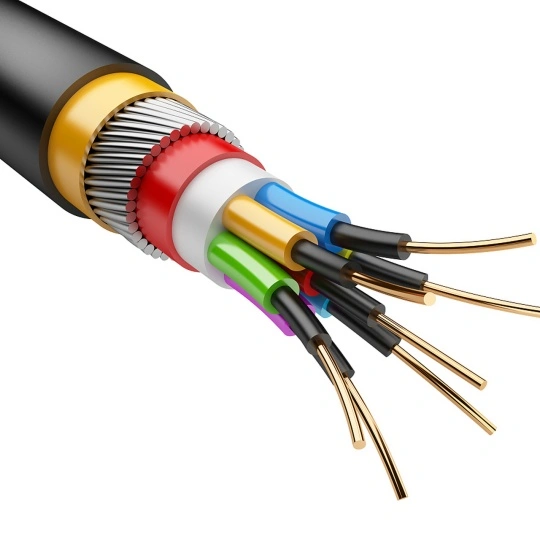
Industrial cables, by contrast, are more complex assemblies engineered to meet the demanding needs of industrial operations. A typical industrial cable consists of multiple insulated conductors (often industrial wires themselves) twisted or bundled together, encased in one or more protective layers. These layers may include a shielding material (such as copper tape or braid) to prevent electromagnetic interference (EMI) or radio frequency interference (RFI), a dielectric layer for insulation, and an outer jacket made from durable materials like PVC, rubber, polyethylene, or fluoropolymers.
The design of industrial cables is tailored to address specific industrial challenges. For instance, cables used in manufacturing plants may have flame-retardant jackets to reduce fire risks, while those in oil and gas facilities are resistant to hydrocarbons and corrosion. Cables for automotive or aerospace applications are lightweight yet capable of withstanding high vibrations and temperature fluctuations. Industrial cables are not just limited to power transmission; they also handle data and signal transmission, such as Ethernet cables for industrial automation systems or coaxial cables for communication equipment. Their ability to integrate multiple conductors and protective features makes them versatile and indispensable in large-scale industrial projects.
To fully grasp the distinction between industrial wires and cables, it’s important to compare them across several critical dimensions:
The most fundamental difference lies in their structure. Industrial wires are single conductors (solid or stranded) with basic or no insulation. Industrial cables, however, are multi-conductor assemblies with layered protection. This structural complexity allows cables to handle multiple electrical circuits simultaneously and provides a barrier against external hazards.
Industrial wires are primarily used for simple, low-power, or single-circuit applications. They are suitable for short-distance connections where environmental conditions are controlled. Industrial cables, on the other hand, are designed for high-power transmission, multi-signal communication, and long-distance connections. They can carry higher current loads, support data transfer at high speeds, and operate reliably in diverse industrial environments.
Industrial wires offer limited protection against harsh conditions. Exposure to moisture, chemicals, extreme temperatures, or physical damage can quickly degrade their performance. Industrial cables, by contrast, are built with robust outer jackets and shielding that resist these elements. For example, a chemical-resistant industrial cable can operate in a factory where it may come into contact with solvents, while a water-resistant cable is suitable for outdoor or wet industrial settings like wastewater treatment plants.
Industrial wires are confined to light-duty, internal, or non-critical applications. Examples include wiring within small motors, connecting basic sensors to controllers, or grounding small equipment. Industrial cables, however, are used in heavy-duty, mission-critical applications across industries such as energy (power generation and distribution), manufacturing (automation lines, robotics), transportation (railways, marine vessels), construction (building wiring for large facilities), and telecommunications (data centers, industrial networks). Without industrial cables, these industries would struggle to maintain efficient and safe operations.
Industrial wires have relatively low performance requirements, focusing mainly on conductivity and basic insulation. Industrial cables, by contrast, must meet stringent standards for current capacity, voltage rating, signal integrity, EMI/RFI shielding, flame resistance, and mechanical strength. For example, a high-voltage industrial cable used in a power plant must withstand thousands of volts without arcing, while a data cable for industrial automation must transmit signals with minimal latency and interference.
As industries become more automated, connected, and demanding, the role of industrial cables has become increasingly vital. Here are some reasons why industrial cables are irreplaceable:
Selecting the appropriate industrial cable requires careful consideration of several factors:
When it comes to industrial cables, quality, reliability, and customization are non-negotiable—and FRS stands out as a leading manufacturer dedicated to meeting these demands. With years of experience in the industrial cable industry, FRS combines cutting-edge technology, strict quality control, and a customer-centric approach to deliver cables that exceed expectations.
At FRS, we understand that every industrial application is unique. That’s why we offer a comprehensive range of industrial cables, including power cables, control cables, data cables, armored cables, and specialty cables tailored to specific industries like energy, manufacturing, and transportation. Our cables are engineered with premium materials—from high-conductivity copper conductors to durable, chemical-resistant jackets—and undergo rigorous testing to ensure they meet or exceed global safety and performance standards (IEC, NEC, CENELEC, etc.).
What sets FRS apart is our commitment to innovation and customer satisfaction. Our team of experienced engineers works closely with clients to understand their specific needs, providing customized cable solutions that optimize performance and reduce downtime. Whether you require a cable for a high-temperature manufacturing line or a water-resistant cable for an offshore project, FRS has the expertise and capabilities to deliver.
In addition to quality products, FRS offers reliable after-sales support, ensuring that our clients receive timely assistance and technical guidance whenever needed. We pride ourselves on our efficient production processes, which enable us to deliver orders quickly without compromising on quality.
For businesses seeking industrial cables that combine durability, performance, and value, FRS is the ideal partner. Trust FRS to power your industrial operations—because when it comes to industrial cables, only the best will do.
Our factory offers high-quality products at competitive prices
Meta Description: Discover high-performance industrial control cable module components designed for seamless automation, harsh environments, and superior connectivity. Explore specs, certifications, and applications. H2: Industrial Con.
In today’s technology-driven world, maintaining uninterrupted signal integrity is critical for industrial, commercial, and residential applications. The Shielded Cable Core is engineered to deliver superior electromagnetic interference .
Feel free to reach out to us for any inquiries or orders.